TL;DR — Key Facts at a Glance
- The best time for Bromo Volcano sunrise is April to October (dry season).
- Peak photography months: May, June, July, and August.
- Sunrise occurs between 5:00–5:35 AM depending on the month.
- Arrive at Penanjakan viewpoint by 4:00–4:30 AM to secure your position.
- The sea of clouds settles inside the Tengger Caldera most reliably from May to August.
- Mount Bromo sits at 2,329 meters above sea level in East Java, Indonesia.
- Pre-dawn temperatures drop to 5°C at the viewpoint during peak dry season.
- Wet season (November–March) offers fewer crowds and uniquely atmospheric, moody conditions.
- Panorama Lens Trip guides operate at Bromo year-round across all weather windows.
Why Timing Is Everything at Mount Bromo
The best time for Bromo Volcano sunrise is April through October, during Indonesia’s dry season. Our guides at Panorama Lens Trip have led photography groups to Bromo’s caldera viewpoints across all twelve months. They have tested every condition — from crystal-clear July mornings to rain-soaked November dawns. The difference between a breathtaking shot and a blank grey frame often comes down to a single week.
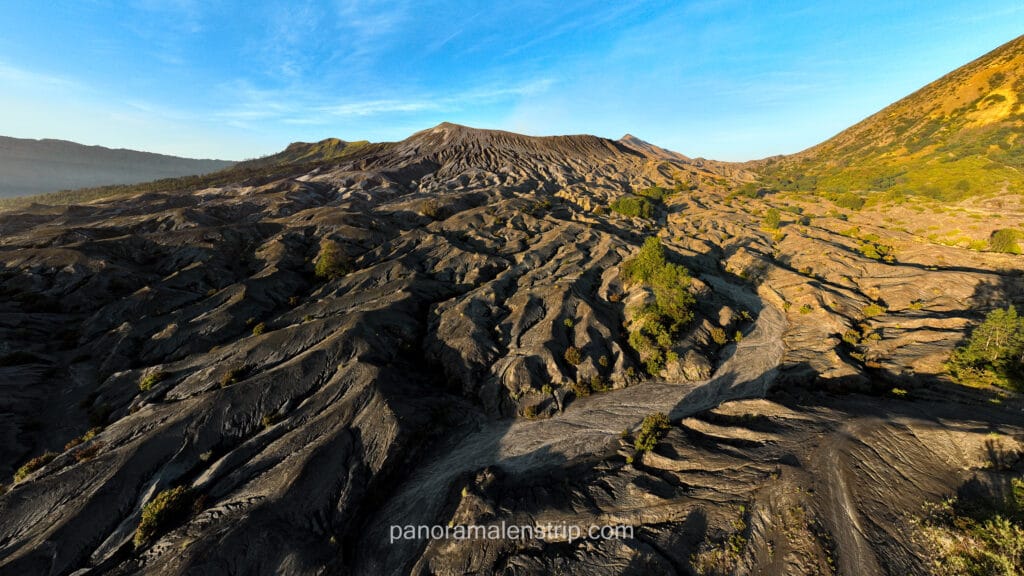
Mount Bromo sits inside the Tengger Caldera in East Java, Indonesia. It rises to 2,329 meters above sea level. The volcanic landscape, shifting sea of clouds, and golden sunrise light make it one of Asia’s most photographed natural sites. Choosing the right month is the single most important planning decision you will make.
What Is the Best Time to See Bromo Volcano Sunrise?
The best time for Bromo Volcano sunrise is the dry season: April through October. May, June, July, and August offer the clearest skies, lowest humidity, and the highest chance of a sea of clouds settling inside the Tengger Caldera at golden hour. This window gives photographers the sharpest horizons and most vibrant light of the year.
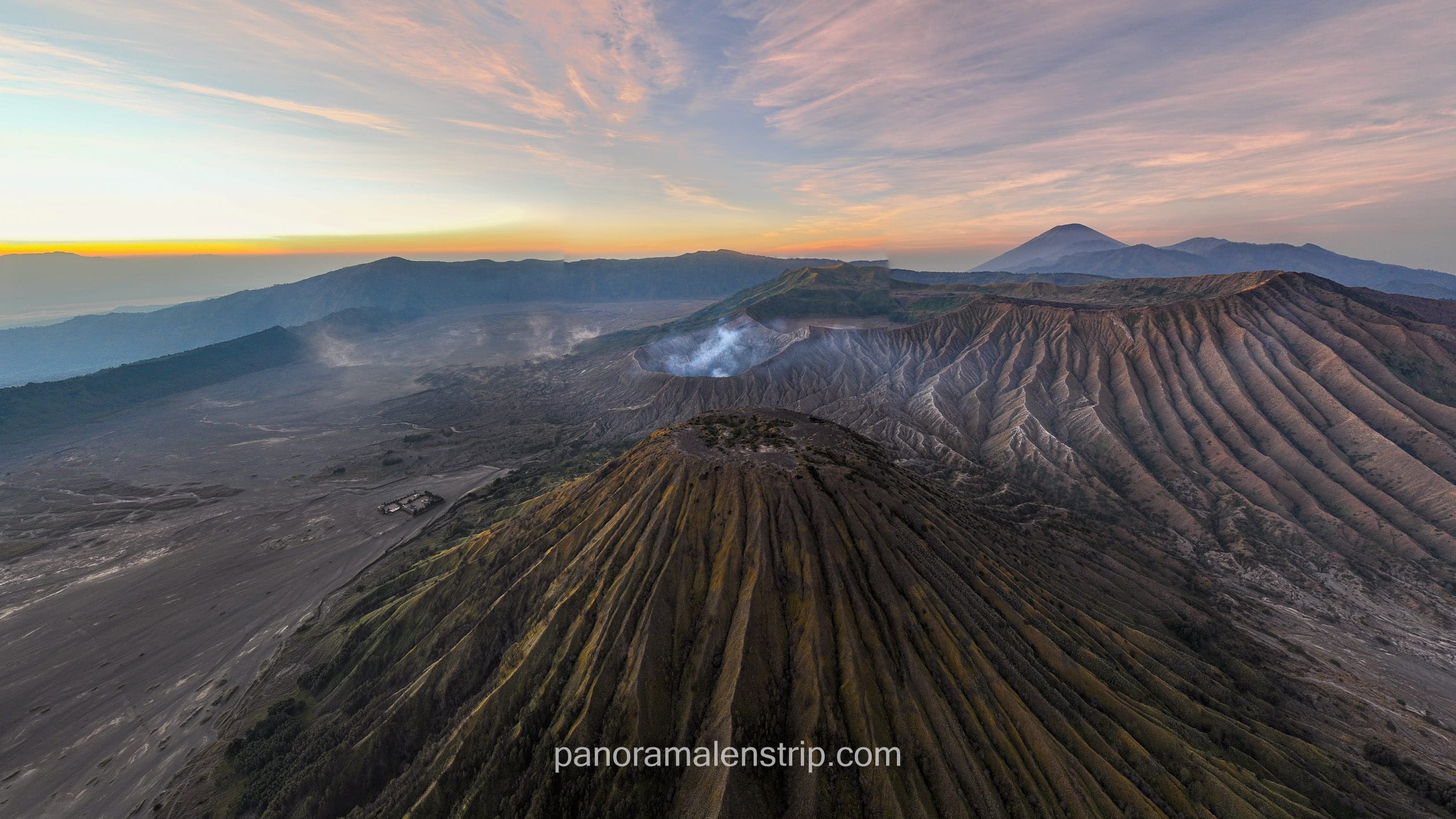
Visibility at Bromo’s Penanjakan viewpoint depends almost entirely on cloud cover and atmospheric humidity. During the dry season, overnight temperatures drop sharply at elevation. This temperature drop causes warm caldera air to condense into the iconic sea of clouds. As golden hour begins, light breaks across the volcanic rim and illuminates the smoke column rising from Bromo’s active crater.
When Is Dry Season at Mount Bromo — and Why Does It Matter?
Which Months Make Up Bromo’s Dry Season?
Bromo’s dry season runs from April through October. The peak photography window sits within May through August. During these months, humidity drops sharply across East Java. This creates the atmospheric clarity that produces the sharp, golden horizons Bromo is globally recognized for.
Overnight temperatures at the Penanjakan viewpoint fall regularly to between 5°C and 10°C during dry season. This sharp cooling causes warm air from the lower caldera to condense into the sea of clouds — a thick white layer that settles at crater level before sunrise. As golden hour begins, light breaks across this cloud formation and illuminates the smoke column and volcanic rim. The result is the layered caldera composition that defines Bromo’s reputation as a world-class photography destination.
Key dry season photography conditions include:
- Sea of clouds: Forms most reliably from May to August inside the Tengger Caldera at sunrise.
- Golden hour quality: Low humidity produces warm, saturated light across the entire caldera rim.
- Full caldera visibility: The active Bromo crater, the Sand Sea floor, and Semeru volcano in the background are clearly visible simultaneously.
- Astrophotography window: Milky Way shots are achievable before dawn on clear new-moon nights from May to August.
What Makes Dry Season Ideal for Sunrise Photography?
Low humidity during Bromo’s dry season directly improves image sharpness. Atmospheric haze diminishes at altitude, allowing wide-angle lenses to capture clean, detailed horizons across the Tengger Caldera. Photographers using focal lengths from 16mm to 70mm will find the best compositional clarity and color depth during these months.
The sea of clouds phenomenon deserves specific attention. It forms when cool mountain air traps warm, moist air rising from the caldera floor. From Penanjakan 1 at 2,770 meters, this cloud layer appears as a white ocean beneath the volcanic peaks. Many landscape photographers rank this as one of Asia’s most compositionally compelling natural events — a perspective that our guides reinforce every season.
Yes, but — here is the nuance most guides skip entirely: Dry season at Bromo is also peak tourist season. By 4:30 AM on a July morning, Penanjakan 1 viewpoint can hold several hundred visitors. Tripod space becomes genuinely competitive. The experience shifts from solitary wilderness photography to a crowded public platform. Arriving by 3:45–4:00 AM and positioning at Seruni Point or Penanjakan 2 instead significantly improves both composition options and the overall experience. Our guides always factor real-time crowd patterns into departure timing.
Also read: Bromo Sunrise Temperature: What to Wear & How Cold It Gets
Is the Wet Season at Bromo Worth Considering for Photographers?
What Happens to Bromo Sunrise During Wet Season?
Bromo’s wet season runs from November through March. During this period, monsoon-driven rainfall and persistent cloud cover frequently obscure sunrise views from Penanjakan viewpoint. Visibility can drop to near zero on heavy rain days. Photography outcomes during wet season depend heavily on local knowledge, pre-dawn timing, and patience with changing conditions.
Heavy cloud cover does not guarantee a lost morning. Brief clearing windows occur — often between 4:30 and 6:00 AM — when overnight rain pauses and mist settles low in the caldera. These moments produce deeply atmospheric, diffused-light images. Adjusting the exposure triangle for low-light fog conditions is essential: higher ISO (800–1600), wider apertures (f/2.8–f/4), and slower shutter speeds with tripod support produce the strongest results.
Are There Hidden Advantages to Visiting Bromo in Wet Season?
Wet season offers real, underrated advantages for committed photographers. Crowds are dramatically smaller. Accommodation rates in Cemoro Lawang drop significantly below peak season pricing. The caldera floor turns vivid green from consistent rainfall. These conditions create a version of Bromo that very few travel images ever capture.
Furthermore, wet season forces compositional creativity. Mist and fog compress depth, isolate the smoke column from background noise, and create an ethereal, painterly quality that dry season clarity cannot replicate. Some of Panorama Lens Trip’s most published Bromo photographs were captured in January and February — months that most generic travel guides dismiss entirely.
What Time of Day Produces the Best Bromo Sunrise Light?
What Is the Golden Hour Window at Mount Bromo?
The golden hour at Mount Bromo begins approximately 30 minutes before official sunrise. It lasts 20–30 minutes after the sun clears the eastern horizon. Sunrise times range from approximately 5:00 AM in June and July to 5:35 AM in December and January. Photographers must be positioned at their chosen viewpoint by 4:00–4:30 AM to capture the full pre-dawn blue hour sequence and the complete golden hour arc.
The pre-dawn blue hour — from approximately 4:00 to 5:00 AM — offers its own distinct creative window. The sky transitions from deep indigo to amber across the volcanic rim. At this stage, the smoke column from Bromo’s active crater reflects ambient sky color, creating a moody, glowing foreground element. Long exposures at this phase — 10 to 30 seconds on a sturdy tripod — produce smooth, cinematic caldera images with significant visual impact.
Sunrise timing reference by month:
- January – February: Sunrise approx. 5:30–5:35 AM
- March – April: Sunrise approx. 5:15–5:20 AM
- May – July: Sunrise approx. 5:00–5:10 AM
- August – September: Sunrise approx. 5:10–5:20 AM
- October – November: Sunrise approx. 5:15–5:30 AM
- December: Sunrise approx. 5:30–5:40 AM
How Does the Bromo Caldera Affect Light and Composition?
The Tengger Caldera’s topography directly shapes every sunrise photography opportunity at Bromo. The caldera is approximately 10 km wide. The flat Sand Sea floor sits at 2,100 meters. Penanjakan 1 rises to 2,770 meters above this floor, providing a commanding elevated perspective over the entire volcanic system.
At golden hour, the sun rises from the east and casts long directional shadows across the Sand Sea. The Bromo smoke column is backlit, creating a translucent, luminous pillar of volcanic gas. Semeru volcano — Indonesia’s highest peak — appears in the far background as a deep silhouette. This layered composition — foreground caldera, midground Bromo crater, background Semeru — is technically unique among volcano sunrise locations across Southeast Asia.
The three primary viewpoints each offer distinct compositional advantages:
- Penanjakan 1 (2,770 m): The classic, most elevated view. Widest caldera perspective across the full volcanic system. Most crowded during peak season.
- Penanjakan 2 (2,680 m): Slightly lower angle. Fewer crowds. Strong foreground rock and vegetation options.
- Seruni Point (2,500 m): Closest to the crater floor. Dramatic low-angle perspective on the smoking crater. Limited space requires earlier positioning.
Besides the daylight, the other light that you can’t leave when visiting Bromo is the Milky Way light. Milky Way photography in this area is limited by the season, which is why you need a better understanding of Mount Bromo Milky Way: Best Time & Photography Spots. Trust me, once you get the Milky Way shots, half of your Mount Bromo tour is complete.
How Do You Plan a Bromo Sunrise Trip from Different Base Cities?
How Far Is Bromo from Surabaya, Malang, and Bali?
Mount Bromo is accessible from three primary base cities. Travel time and logistics vary significantly depending on your departure point. Planning the journey around a pre-dawn 4:00–4:30 AM viewpoint arrival requires precise scheduling and often an overnight drive or a night in Cemoro Lawang.
From Surabaya:
- Distance: approximately 130 km via Pasuruan
- Drive time: 3.5–4.5 hours
- Recommended approach: depart by 11:00 PM for a direct overnight drive, or overnight in Probolinggo and complete the final leg before dawn
From Malang:
- Distance: approximately 75 km via Tumpang
- Drive time: 2.5–3 hours
- Recommended approach: depart by 1:00–1:30 AM for a direct sunrise arrival
From Bali:
- Distance: approximately 120 km from Banyuwangi after the Bali–Java ferry crossing
- Total travel time: 6–8 hours including ferry transit
- Recommended approach: all Bali-based travelers should overnight in Cemoro Lawang the night before their sunrise session
Cemoro Lawang is the primary accommodation hub for Bromo visitors. It sits at the caldera rim, approximately 4 km from Penanjakan. Options range from basic homestays to mid-range hotels with caldera views. Cold-weather layering — thermal base layer, insulated jacket, gloves, and warm hat — is essential for all arrival periods. Even in August, pre-dawn temperatures at the caldera rim fall reliably to 5–8°C.

Can You Combine Bromo with Other Indonesia Photography Destinations?
Mount Bromo pairs naturally with several other world-class photography locations across Indonesia. A well-structured itinerary can combine Bromo with Ijen Crater’s blue fire phenomenon in East Java, Bali’s rice terraces and sea temples, the Komodo dragons and pink beaches of Komodo National Park, and the karst islands and coral reefs of Raja Ampat. Each destination offers a distinct photographic genre — from volcanic landscape to cultural portraiture to underwater macro.
Panorama Lens Trip designs multi-destination photography tour packages across the Indonesian archipelago. These are structured specifically for travelers who want to maximize golden hour windows, minimize transit fatigue, and arrive at every location with the right conditions brief, local knowledge, and technical preparation already handled.
Planning a Bromo sunrise is one decision. Planning a full Indonesia photography journey — from the Tengger Caldera to Bali’s sacred temples and the karst islands of Raja Ampat — requires a completely different level of expertise. Map out your ideal Indonesia photography itinerary with a free, no-obligation route consultation. We handle the logistics. You focus on the light. Contact us!
What Photography Gear Should You Bring for Bromo Sunrise?
Which Camera Settings Work Best at Bromo’s Golden Hour?
The optimal starting camera settings for Bromo sunrise depend on the specific phase of light. Pre-dawn blue hour requires high ISO and wide aperture. As golden hour progresses and light intensity increases, settings shift rapidly. Mastering the exposure triangle at Bromo — the relationship between ISO, aperture, and shutter speed — is essential for capturing each light phase correctly.
Recommended starting settings by phase:
- Pre-dawn (4:00–5:00 AM): ISO 800–1600 | Aperture f/2.8–f/4 | Shutter 10–30 sec (tripod required)
- Blue hour (5:00–5:15 AM): ISO 400–800 | Aperture f/5.6 | Shutter 1–5 sec
- Golden hour (5:15–5:45 AM): ISO 100–200 | Aperture f/8–f/11 | Shutter 1/60–1/250 sec
- Post-sunrise (5:45 AM+): Expose for highlights; use a 3-stop graduated ND filter to balance sky and dark caldera foreground
Shoot exclusively in RAW format at Bromo. The dynamic range challenge — bright sky against a much darker Sand Sea floor — requires significant post-processing latitude. Set white balance to “Cloudy” (approximately 6500K) as a starting point to preserve warm golden tones. Review the histogram after every frame to prevent blown highlights in the sky.
What Lenses and Accessories Are Essential for Bromo?
Two focal length ranges cover the full Bromo compositional spectrum. A wide-angle lens (16–35mm equivalent) captures the scale of the Tengger Caldera and the layered volcanic landscape in a single frame. A medium telephoto lens (70–200mm equivalent) isolates the Bromo smoke column, compresses the background Semeru silhouette, and creates the dramatic stacked-peak compositions that dominate professional Bromo photography portfolios.
The essential accessories list for a Bromo sunrise session:
- Sturdy tripod: Wind at Penanjakan 1 is consistent and strong. A lightweight travel tripod is a liability at this elevation.
- 3-stop graduated ND filter: Balances the bright sunrise sky against the significantly darker caldera floor.
- Circular polarizing filter: Reduces atmospheric haze and deepens sky saturation during dry season conditions.
- Spare batteries (minimum 2): Cold temperatures at 5°C drain battery life rapidly. Keep spares inside an inner jacket pocket against body heat.
- Lens cloth and rain cover: Essential for wet season visits. Volcanic dust from the caldera is also present in dry season.
- Headlamp with red-light mode: Required for jeep-to-viewpoint navigation in complete pre-dawn darkness.
📸 See exactly what your Bromo golden hour shots could look like before you arrive. Browse Panorama Lens Trip’s latest Indonesia photography galleries on Instagram — real images from real conditions captured during our most recent tours.
Each photographer demand perfection thats why choosing the right weather for photography is crucial. Besides the weather, things that needs to be consider is the camera settings. This article will tell you standard camera setting most photographer used while doing photography in bromo: Mount Bromo Photography Guide: Best Camera Settings.
What Should You Expect at the Bromo Sunrise Viewpoints?
What Is Penanjakan Viewpoint and How Crowded Does It Get?
Penanjakan viewpoint is the most recognized sunrise observation point in East Java, Indonesia. It sits at 2,770 meters above sea level on the northern rim of the Tengger Caldera. The viewpoint delivers a direct, unobstructed view of Mount Bromo, Mount Batok, the Sand Sea floor, and Semeru volcano within a single compositional frame. It is consistently ranked among the top ten sunrise photography locations in Southeast Asia.
Crowd levels at Penanjakan 1 peak from June through August. By 5:00 AM on a July morning, the viewing platform regularly holds 300–500 visitors. Jeep convoys begin departing Cemoro Lawang from 3:00–3:30 AM to secure front-row positions along the railing. Arriving after 4:30 AM in peak season means shooting from behind other visitors. Panorama Lens Trip guides consistently recommend Seruni Point as a high-quality, lower-crowd alternative that offers a more intimate and compositionally diverse caldera perspective.
Is Bromo Sunrise Accessible for All Fitness Levels?
Mount Bromo sunrise is accessible to most fitness levels. The Penanjakan viewpoint is reached by 4WD jeep directly from Cemoro Lawang — no hiking is required for the primary sunrise view. The jeep ride takes approximately 30–45 minutes on steep volcanic mountain roads. Post-sunrise, visitors who wish to descend to the crater rim must walk approximately 1.5 km across the Sand Sea, followed by a steep 250-step concrete staircase to the crater lip.
Practical preparation checklist for all visitors:
- Warm, layered clothing: Temperature at the viewpoint falls to 5°C in dry season. Wind chill increases perceived cold significantly.
- Sturdy closed-toe shoes: Required for crater descent across uneven volcanic sand and rocky staircase terrain.
- Face mask or neck buff: Volcanic sulfur gases and fine ash dust are present near the active crater throughout the year.
- Water and snacks: No food services operate at the viewpoint before approximately 6:00 AM.
- Headlamp: Complete darkness at arrival (4:00–4:30 AM) makes a torch essential for safe movement.
Frequently Asked Questions About Bromo Volcano Sunrise
What month is best for Bromo sunrise?
May, June, July, and August are the peak months for Bromo sunrise photography. These months deliver the clearest skies, the strongest sea of clouds formation, and the most vibrant golden hour light over the Tengger Caldera. July and August carry the highest statistical probability of cloud-free mornings based on multi-year weather patterns across East Java.
How cold does it get at Bromo at night?
Temperatures at Penanjakan viewpoint (2,770 m) drop to approximately 5°C during dry season nights in June, July, and August. Wind chill makes the perceived temperature feel significantly colder. Layered thermal clothing, gloves, a warm hat, and a windproof outer layer are essential for every visitor regardless of travel season.
Do I need a guide to visit Bromo sunrise?
A local guide is not legally required but is strongly recommended for photography-focused visits. Navigating jeep logistics, selecting the optimal viewpoint position, timing the departure correctly, and reading real-time cloud conditions all require on-the-ground expertise. Panorama Lens Trip guides hold 12 or more years of site-specific experience at Bromo across all weather conditions and seasons.
Can I see the Milky Way at Bromo before sunrise?
Yes. During dry season months — May through August — on nights with a new or crescent moon, the Milky Way is visible above the Tengger Caldera from approximately 2:00 to 4:00 AM. Astrophotography at Bromo requires a wide-angle lens (14–24mm), maximum aperture (f/1.8–f/2.8), ISO 3200–6400, and a 15–25 second exposure. A sturdy tripod and wireless remote shutter release are both essential for sharp results.
Is Bromo volcanic activity a safety concern for visitors?
Mount Bromo is an active volcano and is monitored continuously by Indonesia’s Center for Volcanology and Geological Hazard Mitigation (CVGHM). A standard exclusion zone of 1 km from the active crater is enforced at all times. Periodic volcanic alert level increases may temporarily restrict visitor access to certain zones. Always verify the current CVGHM alert status before travel. Panorama Lens Trip monitors alert levels daily and adjusts all itineraries proactively in response to any changes.
How long should I stay at Bromo for photography?
A minimum of two nights in Cemoro Lawang is recommended for photography-focused visits. Two consecutive nights provide two separate sunrise attempts — critical insurance against cloud cover or poor atmospheric conditions on a single morning. A three-night stay allows for crater descent photography, Sand Sea exploration at sunrise, and dedicated astrophotography sessions. Multi-night stays also allow guides to optimize departure timing based on real-time atmospheric and cloud conditions.
Conclusion: Choosing Your Bromo Sunrise Window
The best time for Bromo Volcano sunrise is April through October. May, June, July, and August represent the peak photography window. Clear skies, reliable sea of clouds formation inside the Tengger Caldera, and strong golden hour light converge during these months to produce the iconic compositions that define Bromo’s global reputation as a photography destination.
Wet season visits from November to March carry higher uncertainty but deliver genuine photographic rewards: smaller crowds, dramatically lower pricing, vivid green caldera landscapes, and atmospheric mist conditions that almost no published image captures. For photographers willing to adapt their technique to changing conditions, wet season produces some of the most distinctive Bromo imagery possible.
Timing, weather, viewpoint selection, and technical preparation together determine the quality of every image you bring home. Our teams at Panorama Lens Trip operate at Bromo year-round. We photograph this volcano across every season, every light condition, and every weather window — so that when you arrive, every decision is already made.