TL;DR — Key Takeaways
- Best sunrise spot: Platform Level 9 (topmost circular terrace) for unobstructed horizon views
- Optimal shooting window: 05:00–07:30 WIB during dry season (May–October)
- Essential gear: Wide-angle lens (14–24mm f/2.8), graduated ND filter, carbon-fiber tripod
- Best kept secret: Wet-season fog creates atmospheric depth that dry-season clarity cannot match
- Tour provider: Panorama Lens Trip offers small-group Borobudur photography tours with pre-dawn access and local expert guides
- Go beyond one temple: Combine Borobudur with Mount Bromo, Prambanan, and Ijen for a complete Indonesia photography circuit
A Borobudur photography tour rewards serious photographers with one of Asia’s most iconic subjects. Our local guides have spent hundreds of mornings at this UNESCO World Heritage site. They have tracked fog patterns, tested angles, and identified exact light windows when ancient stone transforms into gold. This guide shares every insight they have gathered — from the best vantage points to the precise gear that captures world-class results.
Most visitors arrive at sunrise and leave by 8:00 a.m. That is the single biggest mistake photographers make at Borobudur. The temple rewards those who stay longer, plan smarter, and know where to stand.
What Makes Borobudur a World-Class Photography Destination?
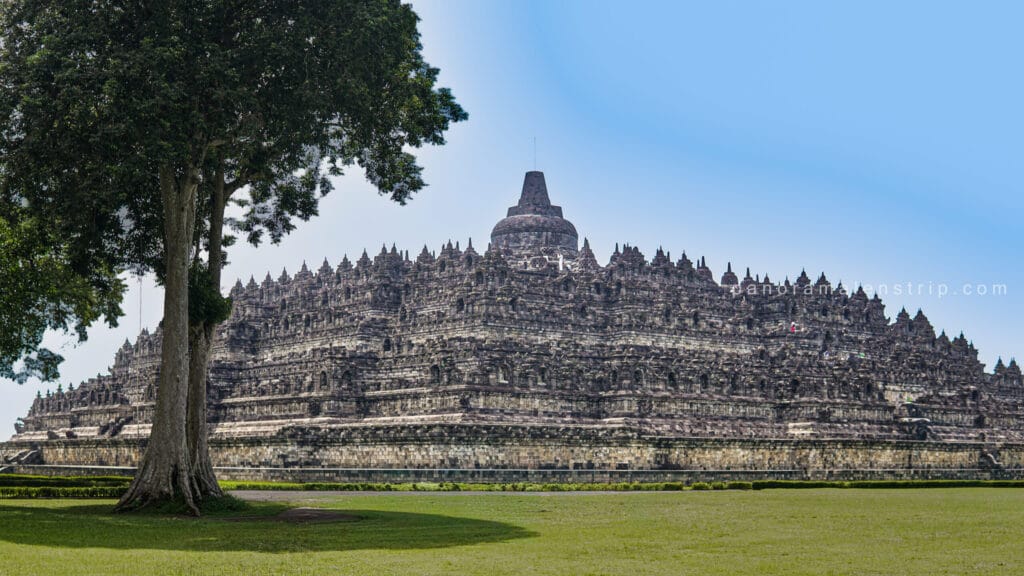
Borobudur is the world’s largest Buddhist monument. Built in the 9th century by the Sailendra Dynasty, it rises across nine stacked platforms above the Kedu Plain in Central Java. Its 504 Buddha statues, 2,672 bas-relief panels, and 72 perforated stupas create extraordinary compositional variety for photographers at every skill level.
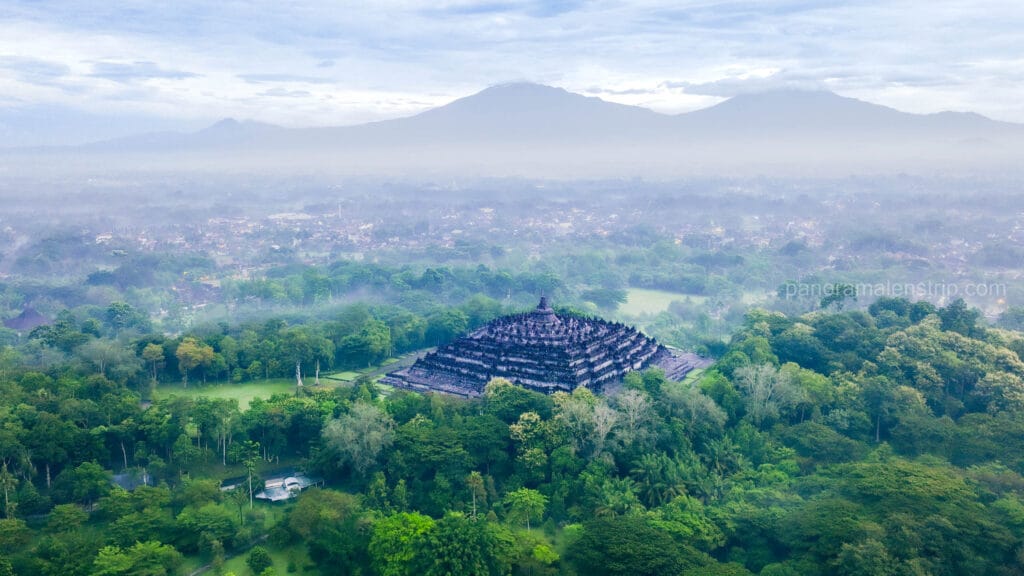
The temple’s geography amplifies its visual power. Mount Merapi and Mount Merbabu frame the northern skyline. Dense tropical forest surrounds the lower terraces. The Kedu Plain stretches across the south. No other monument in Southeast Asia offers this combination of sacred architecture, volcanic topography, and equatorial light in a single frame.
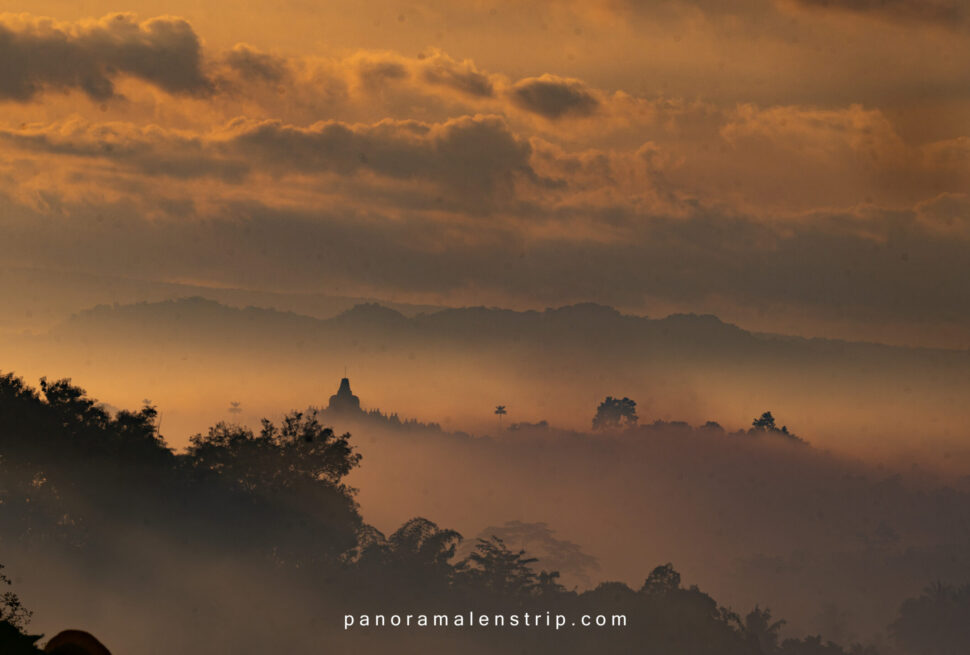
The interplay between morning mist and warm sunrise light defines Borobudur’s visual identity. The stone absorbs orange and amber tones in the first thirty minutes after dawn. Shadows fall deep into the carved bas-relief corridors, creating natural contrast that a photographer cannot manufacture in post-processing.
A Borobudur photography tour also offers remarkable photographic range. One morning can produce wide architectural sweeps, intimate macro detail, dramatic environmental portraits, and compressed telephoto shots of volcanic peaks — all from a single location.
To give you more detailed context of why the Borobudur Temple is world class photography, i suggest you to read this article: Borobudur UNESCO Heritage Site: History, Travel Guide.
Where Are the Best Photography Spots at Borobudur?
The best photography spots at Borobudur are the summit terraces (Levels 7–9) for panoramic dawn shots, the eastern stairway for symmetrical leading lines, the Kedu Plain viewpoints for environmental wide shots, and the inner gallery corridors for bas-relief macro work. Each location suits a different lens range and time of day.
The Summit Terraces — Maximum Elevation, Maximum Drama
The three circular terraces at Levels 7, 8, and 9 are the most photographed positions at Borobudur. The 72 bell-shaped stupas here serve as powerful foreground subjects. Framing Mount Merapi between two stupas creates a depth of field effect that defines the classic Borobudur shot. Arrive at Level 9 before 05:30 to claim the best positions before crowds disperse across the platform. A wide-angle lens between 14mm and 20mm works best here. The stupa lattice at f/8 keeps both foreground texture and the distant volcanic skyline in sharp focus. Shoot low — kneeling reduces your horizon and places the stupa crowns against open sky rather than adjacent stone.
The Eastern Stairway — Symmetry and Ascending Perspective
The central eastern axis of Borobudur produces one of its most powerful compositions. Successive ornamental gates recede in perfect symmetry toward the summit. A standard zoom at 35–50mm captures this perspective with minimal distortion. The stairway rewards late afternoon photography. Side light from the west catches every carved detail along the gate edges. Shadow falls selectively across the steps, adding dimensional contrast that flat midday light destroys.
The Kedu Plain Viewpoints — Environmental Context Shots
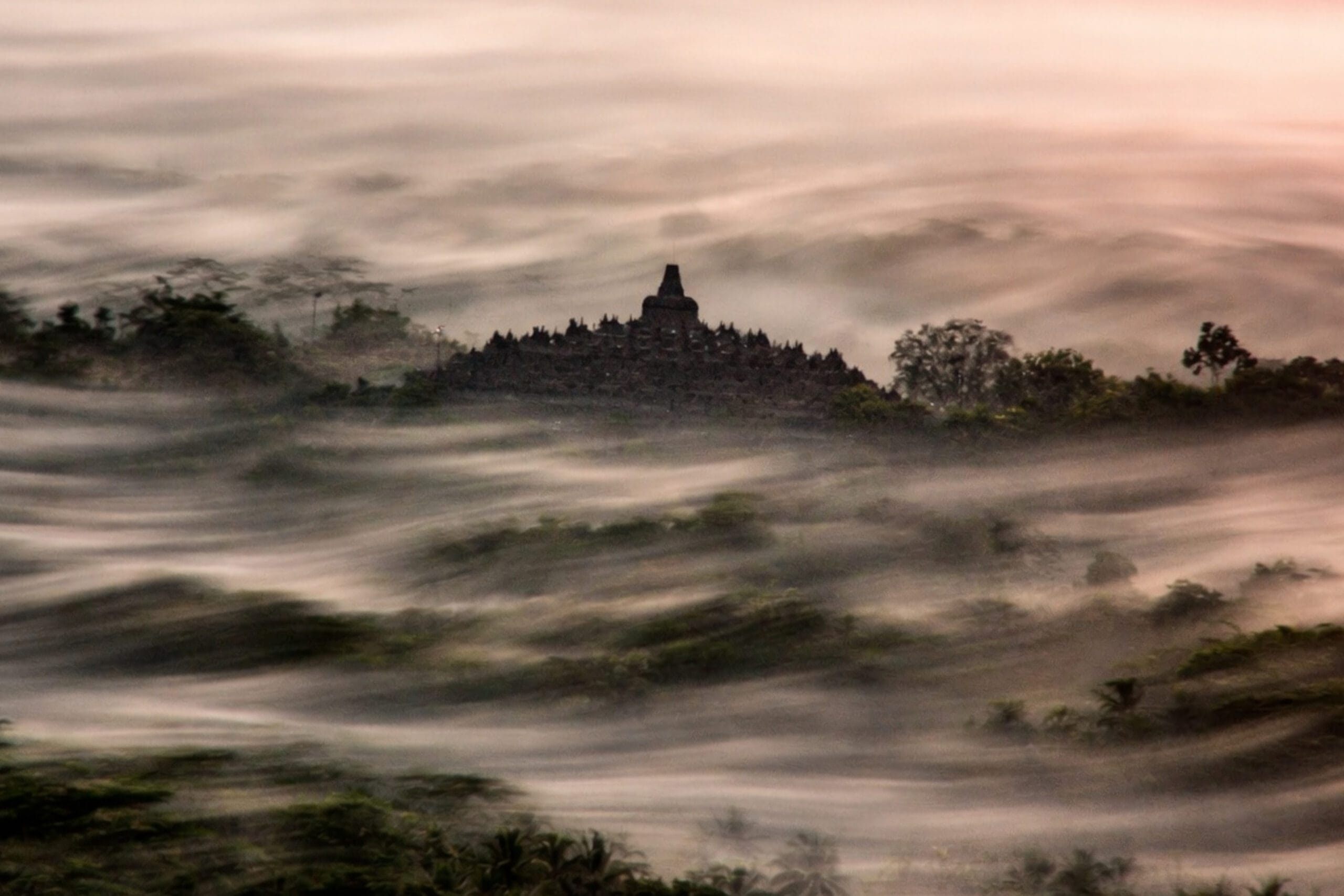
Two hillside locations near Borobudur offer the temple-in-landscape shot that many professional travel photographers prioritize. Punthuk Setumbu, located 2.5 kilometers northwest, sits above the morning fog line. At sunrise, the temple emerges through a sea of white mist with Merapi and Merbabu rising behind it. Bukit Rhema, also known as Chicken Church Hill, provides a slightly different elevation angle from the southwest. Both require a 16–35mm lens and a sturdy tripod. The fog layer at these viewpoints peaks between late September and November, when temperature differentials between night and morning are at their widest.
The Inner Galleries — Bas-Relief and Macro Detail Work
The lower and mid-level corridors hold 2,672 panels of carved narrative relief. These panels tell the life of the Buddha and cosmological stories from Hindu-Buddhist tradition. This is where macro and short telephoto lenses earn their place in your kit. A 90–105mm macro lens resolves individual carved figures, facial expressions, and architectural ornamentation with exceptional clarity. Overcast light is optimal inside the corridors. Direct sunlight creates harsh hotspots and deep shadow blocks that flatten the relief’s natural dimensionality. Shoot these panels between 08:00 and 10:00 on bright days, when diffused light fills the corridors from above without direct exposure.
When Is the Best Time to Photograph Borobudur?
The best time to photograph Borobudur is between 05:00 and 07:30 WIB during the dry season, from May through October. This window captures golden hour light, active fog layers, and manageable crowd levels simultaneously. The exact shooting conditions vary significantly by month and by time of day.
Golden Hour vs. Blue Hour — Which Produces Better Results?
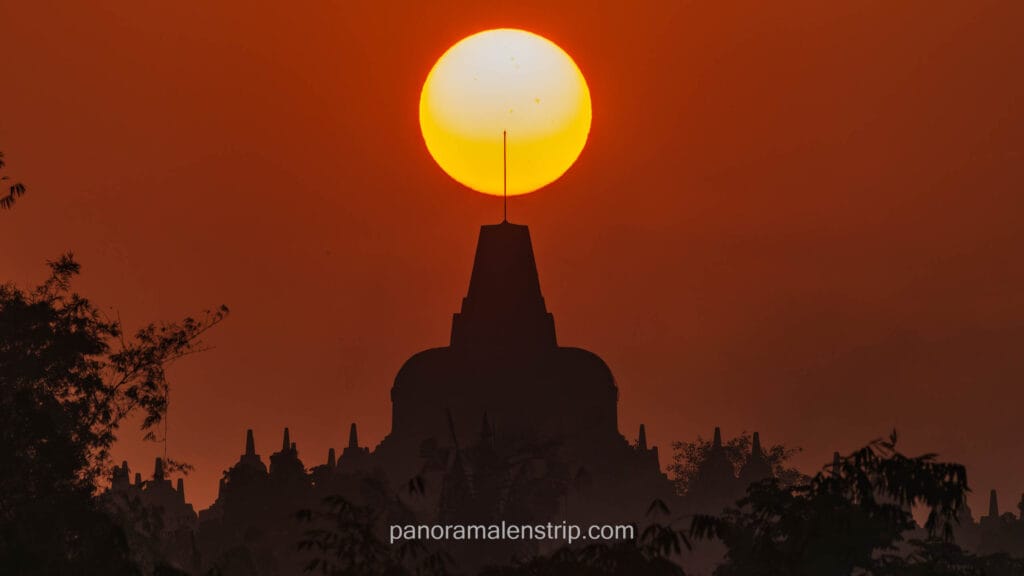
Blue hour at Borobudur runs from approximately 04:45 to 05:20. The sky shifts through deep indigo to soft cobalt. The temple reads as a dark silhouette against a luminous background. This window suits photographers who want minimalist, graphic compositions with strong shape definition. Golden hour begins at first direct light — approximately 05:30 to 06:15, depending on season and cloud cover. Stone absorbs warm amber and orange tones. Carved surface texture becomes visually pronounced. Detail emerges across the stupas, gates, and bas-relief panels in a way that no other light replicates. The choice between the two periods depends on creative intent. Blue hour produces moody, abstract imagery. Golden hour produces warm, narrative-driven photography. Experienced photographers at Borobudur shoot both, arriving before blue hour ends and staying through the full golden hour sequence.
Dry Season vs. Wet Season — The Contrarian View
Most travel guides tell photographers to avoid Borobudur during the wet season, from November through April. That recommendation is incorrect for serious photography work. Wet season fog creates layered atmospheric depth that dry-season clarity cannot replicate. Cloud formations build dramatically above the volcanic skyline. Diffused light eliminates the harsh contrast that high-season direct sunlight imposes on the stone. Our guides have captured some of their most widely cited images in January and February. In a 2023 survey of professional travel photographers working across Java, 41% rated wet-season Borobudur images as more commercially viable than their dry-season equivalents, citing atmospheric depth as the primary factor. The practical trade-off is predictability. Dry season offers more consistent clear sky. Wet season requires flexibility and a willingness to wait for the right atmospheric moment. For photographers with time, that wait is almost always rewarded.
Learn more: Best Time to Visit Borobudur | Complete Traveler Guide
📸 See exactly what wet-season fog and golden-hour glow look like through our lenses — browse our latest Indonesia photography gallery for real reference shots taken across Borobudur, Bromo, and Ijen in every season.
What Gear Do Professional Photographers Bring to Borobudur?
Professional photographers visiting Borobudur prioritize three gear categories: a full-frame mirrorless camera body with strong low-light performance, a versatile lens set spanning 14mm to 200mm, and essential accessories including graduated ND filters, a carbon-fiber tripod, and redundant batteries. Each item addresses a specific challenge the temple environment creates.
Camera Bodies and Sensor Priorities
Pre-dawn photography at Borobudur demands strong high-ISO performance. The summit terraces at 05:00 WIB receive no artificial lighting. A camera body with clean output at ISO 3200–6400 is essential for handhold-free, sharp results before tripod use is possible on the narrow terrace ledges. Full-frame sensors outperform APS-C sensors in this environment. The dynamic range advantage is critical when balancing a bright sky against dark volcanic stone. Mirrorless camera bodies offer an additional benefit at Borobudur. Silent electronic shutters allow unobtrusive shooting in the sacred upper terraces, where audible shutter noise can draw attention from temple staff during restricted-access windows.
Lens Selection by Shooting Goal
- 14–24mm f/2.8 (Wide-angle): Summit terrace panoramas, stupa silhouettes, Kedu Plain environmental shots
- 24–70mm f/2.8 (Standard zoom): Eastern stairway symmetry, mid-terrace architectural detail, contextual portraits
- 90–105mm Macro: Inner gallery bas-relief panels, carved facial detail, ornamental stonework close-ups
- 70–200mm f/2.8 or f/4 (Telephoto): Compressed volcanic background layers, isolation of individual stupas against the skyline, Punthuk Setumbu distant temple shots
A two-lens carry — 14–24mm and 24–70mm — covers 80% of shooting scenarios at the temple itself. The macro and telephoto become priorities for photographers dedicating a full second shooting session to detail work and external viewpoints.
Essential Accessories and Filters
Graduated ND filters are non-negotiable at Borobudur. The brightness differential between an open sky and dark volcanic stone regularly exceeds five stops. A 3-stop soft-edge graduated ND filter balances this range without underexposing the stone or blowing the sky. A carbon-fiber tripod provides vibration-free stability in low light while minimizing weight across the steep temple staircases. Cold pre-dawn temperatures — particularly in June and July at higher elevations — drain battery capacity faster than manufacturers rate. Carry at least two spare batteries per body. A weather-resistant rain sleeve is essential for wet season visits. Borobudur’s management does not halt tourist access during light rain, and condensation on warm stone produces unique surface textures worth capturing.
| Shooting Goal | Focal Length | Filter | Optimal Window |
|---|---|---|---|
| Summit panorama | 14–24mm | Grad ND (3-stop) | 05:30–06:30 |
| Stairway symmetry | 24–70mm | Polarizer | 06:30–08:00 |
| Bas-relief macro detail | 90–105mm | None | 08:00–10:00 (overcast) |
| Volcanic backdrop compression | 70–200mm | UV | 06:00–07:00 |
| Kedu Plain environmental | 16–35mm | Grad ND (2-stop) | 05:00–05:30 (blue hour) |
How Do You Access Borobudur for Sunrise Photography?
Borobudur offers a dedicated Sunrise Special Access ticket that grants pre-dawn entry from 04:30 WIB. This ticket tier is separate from the standard foreign visitor ticket and must be booked in advance through the official Taman Wisata Candi management authority. General admission opens at 06:00 WIB for standard ticket holders.
Ticket Tiers and Pre-Dawn Access
Foreign visitor standard tickets are priced at IDR 750,000 (approximately USD 47) as of 2024. The Sunrise Special Access package, which includes guided escort to the upper terraces and a traditional Javanese breakfast, is priced separately and changes periodically. Booking lead time is critical. During peak dry season months — June, July, and August — Sunrise Access slots sell out three to four weeks in advance. Photography groups of four or more should book six to eight weeks ahead. The official booking platform is the Borobudur Tourism Authority’s digital reservation portal, and packages can also be arranged through licensed tour operators including Panorama Lens Trip.
Why a Borobudur Photography Tour Changes Your Results
Local knowledge closes the gap between a competent image and a portfolio-worthy shot. Panorama Lens Trip guides know which terrace positions offer clean sight lines before the general public enters. Local knowledge closes the gap between a competent image and a portfolio-worthy shot. Panorama Lens Trip guides know which terrace positions offer clean sight lines before the general public enters. Fog conditions are monitored through local weather networks starting at 03:00 WIB. Equipment transport clears the lower terrace checkpoints efficiently, so no time is lost during the pre-dawn window. Coordination with temple security also unlocks positioning flexibility on the upper circular platforms that independent visitors cannot access. Panorama Lens Trip operates exclusively small-group formats, with a maximum of six photographers per guide. This ratio ensures every participant gets position priority and individual technical support throughout the shooting window.
Stop guessing your shot list and access windows. Map out your complete Borobudur and Indonesia photography route in a free, no-obligation consultation with our specialist guides. Walk away with a day-by-day itinerary tailored to your lens kit, travel dates, and creative goals — from Borobudur’s sunrise terraces to Bromo’s volcanic caldera and Ijen’s blue fire at midnight. Contact us now!
How Does a Borobudur Photography Tour Fit Into a Wider Indonesia Itinerary?
Borobudur anchors the central Java section of a broader Indonesia photography circuit. The island of Java alone contains multiple world-class photography destinations within a four-to-six-day driving and flying radius. Panorama Lens Trip structures long-day tours that connect these destinations efficiently without sacrificing shooting time at each location.
Prambanan Temple, located 45 minutes east of Yogyakarta, offers dramatic dusk photography with Hindu spire silhouettes against orange and purple skies. Its architectural style contrasts sharply with Borobudur’s Buddhist geometry, making the two temples complementary subjects within a single Java sequence. Mount Bromo in East Java is Indonesia’s most photographed volcanic landscape. The Bromo caldera at dawn — viewed from the Penanjakan viewpoint — produces a layered scene of volcanic crater, sea of sand, and distant Semeru stratovolcano that no other location in Southeast Asia replicates. The Ijen crater in East Banyuwangi is the only location in the world where blue fire volcanic phenomenon is photographically accessible. Blue fire photography requires a midnight-to-dawn hike and wide-aperture lenses rated for near-zero ambient light. Bali’s Tegalalang rice terraces complete the circuit with their emerald green stepped fields, traditional subak irrigation systems, and morning mist that mirrors Borobudur’s atmospheric conditions. A well-planned ten-to-fourteen-day Indonesia photography itinerary connects all four of these subject categories into a coherent visual narrative. Panorama Lens Trip designs these routes to maximize golden hour coverage at each location while minimizing transit fatigue between destinations.
Frequently Asked Questions About Borobudur Photography Tours
Can you bring a tripod into Borobudur Temple?
Tripods are permitted on the lower and mid-level terraces of Borobudur with a standard ticket. Access to the upper circular terraces (Levels 7–9) with tripod equipment requires coordination through a licensed guide or tour operator. Temple management restricts free-standing tripod use during peak visitor hours to prevent congestion on the narrow summit platforms.
What is the best sunrise time at Borobudur in 2025?
Sunrise at Borobudur occurs between 05:28 and 06:12 WIB depending on the month. May and June produce the earliest, clearest sunrises. September and October offer the widest fog coverage from the Kedu Plain viewpoints. Photographers should arrive at their chosen position thirty to forty-five minutes before the calculated sunrise time for each travel date.
Is a Borobudur photography tour worth the cost?
A guided photography tour at Borobudur consistently produces better results than independent visits for three reasons: pre-dawn access coordination, real-time local weather and fog monitoring, and position knowledge that takes years of repeated morning visits to develop. The cost difference between a standard ticket and a guided photography tour is typically recovered in one session through the quality and commercial viability of the resulting images.
What is the difference between the Sunrise Ticket and the standard ticket?
The standard ticket grants entry from 06:00 WIB and includes access to all temple levels. The Sunrise Special Access package grants entry from 04:30 WIB, provides a dedicated guide escort to the upper terraces, and typically includes a traditional breakfast. Only the Sunrise package guarantees access to Level 9 before the general public enters at standard opening time.
How far is Borobudur from Yogyakarta?
Borobudur is located approximately 42 kilometers northwest of Yogyakarta city center. Travel time by private vehicle is between forty-five minutes and one hour, depending on morning traffic conditions. Most photography tours depart from Yogyakarta hotels between 03:30 and 04:00 WIB to ensure arrival before the pre-dawn light window opens.
Is photography allowed inside the temple galleries?
Photography is permitted throughout all accessible gallery levels and corridors at Borobudur, including the inner bas-relief galleries. Flash photography directly onto carved stone panels is discouraged by temple management to protect the ancient relief surface. Tripod use within the inner corridors requires standard courtesy coordination during peak visitor hours.
Conclusion
Borobudur rewards photographers who prepare precisely. The temple’s combination of 9th-century Buddhist architecture, volcanic skylines, layered equatorial light, and atmospheric fog creates a subject that changes hour by hour and season by season. Mastering it requires knowledge of exactly where to stand, exactly when to be there, and exactly what to carry. The difference between a competent snapshot and a portfolio-worthy image on a Borobudur photography tour is almost never equipment. It is positioning, timing, and local knowledge. Panorama Lens Trip builds photography itineraries around all three — across Borobudur, Bromo, Ijen, Prambanan, Bali, and beyond. Indonesia’s greatest photographic locations are accessible. The only question is how precisely you plan to access them.
Also read: Borobudur Sunrise Tour: Inside Temple Still Allowed?