TL;DR
- Best months overall: June, July, and August (dry season peak)
- Best time for blue fire: Midnight to 3 AM — total darkness is essential
- Best time for crater photography: Pre-dawn arrival (4–5 AM) for golden hour light
- Avoid if possible: November through March (heavy rain, poor visibility, slippery trails)
- Key safety item: A full-face respirator mask — not an optional accessory
- Panorama Lens Trip offers guided photography tours combining Ijen with Mount Bromo, Bali, and beyond
The best time to visit Ijen Crater is during the dry season, from June through August. This window delivers the clearest skies, the safest trails, and the most dramatic blue fire visibility. Our local guides have tracked weather patterns and trail conditions at Ijen for years. This guide gives you everything you need to plan your visit around safety, photography, and peak natural spectacle.
When Is the Best Time to Visit Ijen Crater?
The best time to visit Ijen Crater is between June and August, during Indonesia’s dry season. Midnight to 3 AM is the optimal window for blue fire. Pre-dawn arrival (4–5 AM) delivers the best golden hour photography over the turquoise sulfuric lake. Dry season trail conditions reduce slipping hazards on the steep 3 km ascent.
Two variables define your Ijen experience above all others. The first is the season — dry versus wet. The second is the time of day — specifically, how early you begin your ascent. Get both right, and Ijen delivers one of the most visually extraordinary experiences on Earth. Get either one wrong, and the reward shrinks considerably.
What Are the Two Best Seasons to Visit Ijen Crater?
Why Is the Dry Season (June–August) the Top Choice?
June, July, and August offer the lowest rainfall, the clearest atmospheric conditions, and the most stable trail surfaces. These three months represent the undisputed peak window for visiting Ijen Crater. Visibility above the caldera rim averages its annual maximum. Blue fire contrasts sharply against a dark, cloud-free sky.
Trail conditions during dry season are firm and predictable. The 3 km volcanic gravel path dries quickly after any brief overnight shower. Sulfuric mist from the crater tends to drift more predictably in dry-season wind patterns. This allows guides to position groups safely upwind of the heaviest gas concentrations.
Photography conditions peak during these months. The turquoise sulfuric lake — the world’s largest acidic volcanic lake — reflects pre-dawn light with exceptional clarity. Wide-angle lenses capture the full caldera bowl without moisture distortion on the front element. Long-exposure blue fire shots benefit from stable, windless conditions common in July.
Are the Shoulder Months (April–May and September–October) Worth Considering?
Shoulder months offer a genuine alternative for experienced travelers. April, May, September, and October carry moderate rain risk but significantly lower crowd density. Blue fire visibility remains high on clear nights. Trail conditions are generally acceptable, though wet spells can cause brief closures.
What Time of Day Gives You the Best Ijen Crater Experience?
Time of day is as critical as season when planning your Ijen visit. Two distinct windows each offer a different, irreplaceable reward. Missing either one by even an hour changes the experience entirely. Most serious visitors target both windows on a single ascent — beginning at midnight and staying through sunrise.
When Can You See the Ijen Blue Fire Phenomenon?
The Ijen blue fire is only visible between midnight and approximately 3 AM, in complete darkness. The phenomenon occurs when sulfuric gases combust upon contact with air at the crater’s vents. The resulting flames burn at wavelengths that appear electric blue — invisible in daylight. No other location on Earth offers this phenomenon at accessible scale.
The blue fire is not lava. It is burning sulfuric gas igniting as it escapes through volcanic fissures. Flames reach up to 5 meters in height. Temperatures at the vent sites exceed 600°C. The visual effect is extraordinary — a flowing, luminous blue river moving across dark volcanic rock.
Arriving at the crater rim by 12:30 AM gives you the maximum viewing window. Guides begin the 3 km ascent from Paltuding basecamp at around 11 PM. A moderate trekking pace covers the elevation gain comfortably in 90 minutes. Faster trekkers can reach the rim in under an hour.
It may be bad news for you, because sometimes ijen blue fire phenomenon are closed due to several reason. You may learn about the closure of mount ijen and the other things you can do besides blue fire: Ijen Blue Fire Temporarily Closed: 2026 Travel Status & Guide
What Is the Best Time for Ijen Crater Photography and Golden Hour Shots?
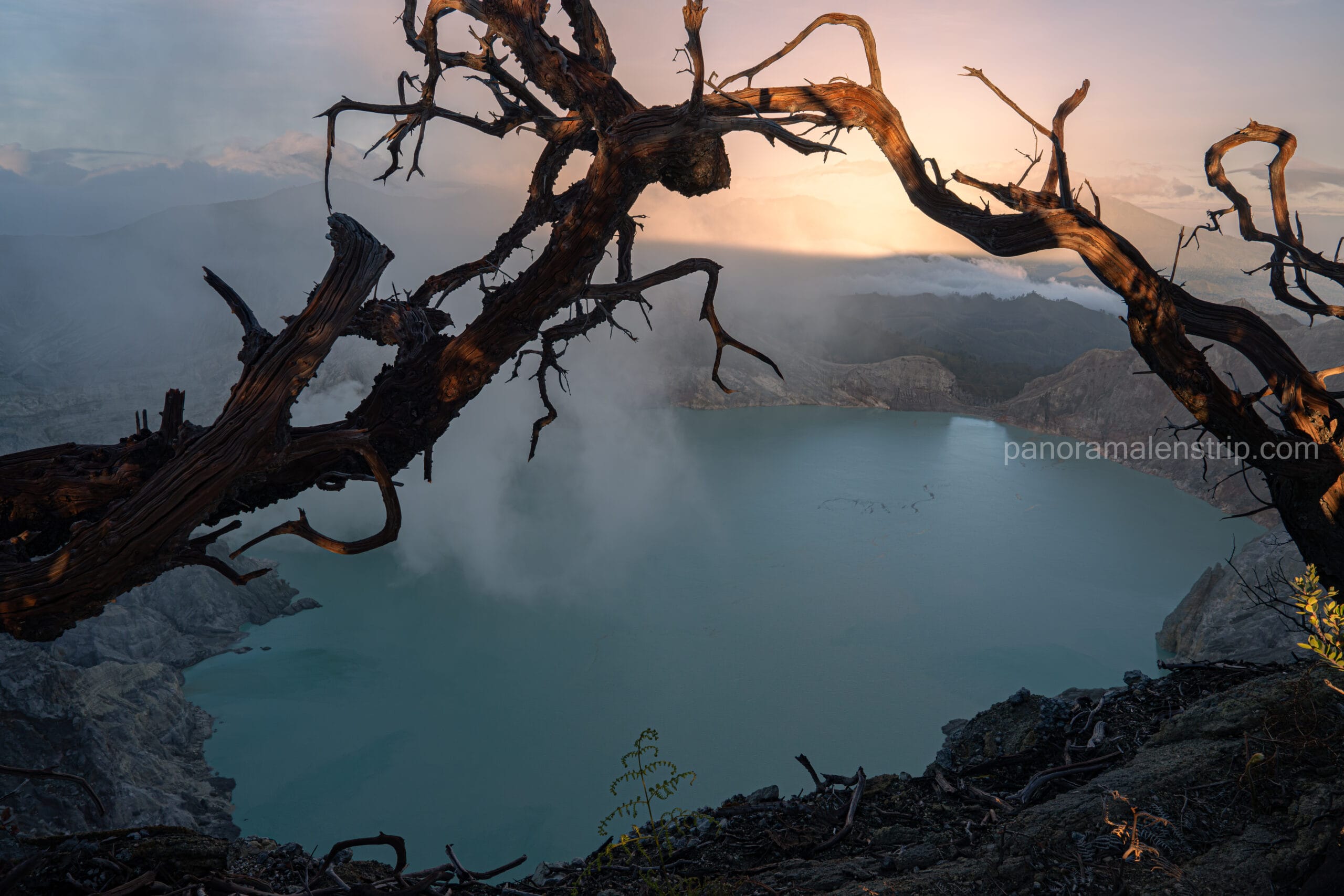
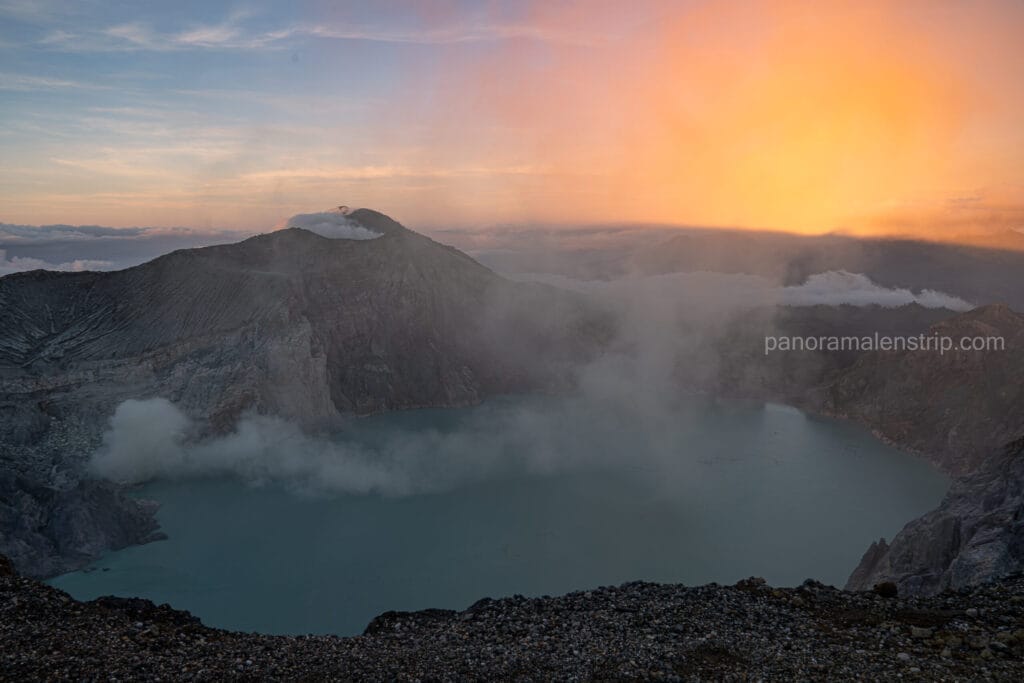
Pre-dawn arrival — between 4 and 5 AM — positions you perfectly for golden hour photography over the caldera. The turquoise sulfuric lake catches the first warm light as the sun rises behind the eastern ridge. This window is the most photographically rewarding moment of the entire Ijen experience.
The exposure triangle requires careful management at this hour. ISO performance becomes critical — the transition from blue fire darkness to pre-dawn twilight spans a 6–8 stop range within 90 minutes. A wide-angle lens (14–24mm range) captures the full caldera topography. A fast aperture (f/2.8 or wider) remains essential for the low-light volcanic mist environment.
The turquoise lake — officially named Kawah Ijen — sits at an elevation of 2,148 meters. Its acidic pH of 0.5 gives the water its distinctive mineral color. Volcanic mist rises from the surface as temperatures drop overnight. This mist creates natural diffusion that softens light beautifully for landscape photography.
📸 See exactly what your Ijen golden hour frames could look like. Explore our most recent crater galleries on Instagram — real shots from real mornings at the rim, captured by Panorama Lens Trip photographers and our guests.
How Does the Rainy Season Affect an Ijen Crater Visit?
Is It Safe to Visit Ijen Crater During the Rainy Season (November–March)?
Visiting Ijen during the rainy season (November through March) is possible but significantly less rewarding. Rain reduces trail traction on the volcanic gravel surface. Cloud cover obscures blue fire visibility and eliminates clear golden hour light. Wet conditions also accelerate lens fogging in the sulfuric environment.
The Indonesian Meteorological Agency (BMKG) records the highest Ijen-area rainfall between December and February. Average monthly rainfall in this period exceeds 300mm in the surrounding lowland zone. At summit elevation, precipitation combines with volcanic mist to create near-zero-visibility conditions on many nights. Trail closures during this period are not uncommon.
The risks are manageable for experienced, well-equipped trekkers. However, first-time visitors and photography travelers gain far less value from a wet-season visit. The trade-off — lower cost and fewer crowds — rarely compensates for what is lost in visibility and image quality.
How Do Rain and Cloud Cover Impact Blue Fire and Lake Photography?
Cloud cover at crater elevation effectively erases the blue fire visual. Even partial cloud layers diffuse and scatter the faint blue light, reducing it to an indistinct glow. Long-exposure photography requires a completely dark, cloud-free sky to capture the phenomenon clearly. Rain also introduces significant lens moisture risk in an environment already saturated with sulfuric vapor.
Lake photography suffers equally. The turquoise color of Kawah Ijen requires direct or soft-diffused light for accurate rendering. Heavy cloud cover shifts the lake’s apparent color toward grey-green. Golden hour loses its character entirely under an overcast sky. Photographers targeting the lake’s iconic mineral hue should prioritize dry-season visits without exception.
The best travel experience of course needs sophisticated planning. One of the aspects you need to consider while planning to Ijen Crater is the Weather. This article may help you about it: Best Season for Ijen Sunrise: Weather, Months & Tips
What Safety Factors Should You Know Before Trekking to Ijen Crater?
Safety at Ijen Crater depends on two things: the right equipment and the right information. The volcanic environment presents real, manageable risks. Our guides brief every guest comprehensively before departure. Understanding these factors in advance makes the difference between a confident ascent and an anxious one.
How Dangerous Is the Sulfur Gas at Ijen Crater?
Sulfur dioxide (SO₂) concentrations at Ijen Crater’s active vent zone are genuinely hazardous without respiratory protection. Exposure without a proper mask causes immediate eye and throat irritation. Prolonged unprotected exposure risks acute respiratory damage. A full-face respirator with the correct filter cartridge is non-negotiable equipment — not an optional accessory.
A standard dust mask or surgical mask provides zero protection against SO₂. The correct specification is a half-face or full-face respirator with acid gas filter cartridges (typically Type A or ABEK). Many visitors rent basic masks at the basecamp — most of these are inadequate. Panorama Lens Trip provides certified respirators as standard equipment for all guided crater descents.
VOG — volcanic smog — can shift direction rapidly as wind changes at the rim. Guides position groups upwind of the primary vent. If wind direction reverses, the protocol is to move immediately. Staying calm and moving fast in the correct direction eliminates most gas exposure risk.
What Are the Official Trekking Hours and Entry Regulations?
Paltuding basecamp — the official starting point — opens at 11 PM for nighttime trekking. Gates close at 2 AM for new entries. The trail itself closes periodically based on volcanic activity alerts from the Center for Volcanology and Geological Hazard Mitigation (PVMBG). Current activity levels are publicly posted and updated regularly.
Entry requires a valid national park ticket, purchased at the Paltuding gate. Foreign visitors pay a separate rate from domestic visitors. Group size limits apply for guided crater descent — the area immediately adjacent to the active vent is restricted. Solo trekking to the crater floor is strongly discouraged by park management.
Photography permits are not separately required for personal or commercial use at this time. However, drone operation within the national park boundary requires advance authorization. Any commercial film production requires coordination with the Banyuwangi regional government office.
Learn more about how difficult ijen to hike and the full guide to hike for safety : Ijen Crater Hike Difficulty: Health & Gas Mask Safety
How Does Ijen Compare to Other Indonesia Photography Destinations by Season?
Ijen Crater fits naturally within a broader East Java and Indonesia photography itinerary. Its dry season window (June–August) aligns directly with peak conditions at Mount Bromo, just three hours to the west. This alignment makes a combined Ijen–Bromo photography route exceptionally efficient in terms of travel timing.
Kelimutu, located on Flores island, also peaks during the May–October dry season. Bali’s iconic rice terraces photograph best during the post-harvest period (July–September) when field geometry is sharpest. The geographic spread of these destinations means a multi-week Indonesia photography tour can target all of them within a single optimal season window.
Ijen’s blue fire phenomenon is unique among these destinations. Bromo offers the iconic sea-of-sand sunrise. Kelimutu presents three crater lakes of shifting color. Bali provides cultural and agricultural depth. Together, these locations represent one of the most photographically diverse itineraries available anywhere in Southeast Asia.
🗓️ Your Indonesia photography route — from Ijen’s blue fire and Bromo’s golden sunrise plains to the color-shifting lakes of Kelimutu — deserves more than guesswork. Map out your perfect multi-destination itinerary with a free, no-obligation route consultation from the Panorama Lens Trip planning team. [Contact us now!]
What Gear Do You Need for the Best Ijen Crater Visit?
What Camera and Lens Setup Works Best for Ijen Blue Fire Photography?
A fast wide-angle prime lens is the single most important piece of photography equipment at Ijen. The 14mm f/1.8 or 20mm f/1.4 specification covers the full caldera bowl while maintaining the aperture needed for blue fire exposure. A full-frame sensor body with strong high-ISO performance — 3200–6400 range with clean output — handles the pre-dawn transition effectively.
Blue fire long exposures require a sturdy tripod with a ball head capable of locking precisely on uneven volcanic terrain. Shutter speeds typically range from 8–30 seconds depending on flame intensity. Remote shutter release eliminates vibration at these exposures. A second, shorter lens (35–50mm equivalent) is useful for compressed lake and rim portrait shots after sunrise.
Lens fogging is a serious operational challenge. The temperature differential between cool night air and warm sulfuric vapor condenses moisture rapidly on front elements. Carry at least four lens cloths. A anti-fog UV filter provides a sacrificial protective layer. Keep rear element caps on all non-mounted lenses to prevent internal condensation.
Also read: Best Camera Settings for Ijen Sunrise Shots
What Protective Gear Is Essential for the Ijen Crater Trek?
The following items are required, not optional, for a safe Ijen trek:
- Full-face respirator with acid gas filter cartridges (SO₂ rated)
- Headlamp with minimum 200 lumens output and fresh batteries
- Trekking boots with ankle support and grip soles — trail runners are insufficient
- Layered clothing — summit temperatures drop to 8–12°C before dawn
- Waterproof jacket — volcanic mist creates a persistent light-rain effect regardless of season
- Trekking poles — strongly recommended for the steep descent on loose volcanic gravel
- Weatherproof camera bag or rain cover for all photography equipment
- 1.5 liters of water minimum — hydration at altitude is easily underestimated
Sulfur deposits on skin and clothing are a minor but real concern. Wearing long sleeves and a neck gaiter reduces skin contact. Washing hands and face immediately after descending from the crater floor removes residue effectively.
Especially for you who used to bring drone while you’re traveling for photography or documentation purpose. I suggest you to read this article to learn more about tips to fly drone in Ijen Crater.
Frequently Asked Questions About the Best Time to Visit Ijen Crater
Can You See the Blue Fire at Ijen Crater During the Day?
No. The Ijen blue fire is completely invisible in daylight. The flames are visible only between approximately midnight and 3 AM in conditions of total darkness. During daylight hours, the crater is worth visiting for the turquoise lake views, but the blue fire phenomenon requires a nighttime ascent.
How Long Does the Ijen Crater Trek Take?
The one-way trek from Paltuding basecamp to the crater rim takes 60 to 90 minutes at a moderate pace. The full round trip — including time at the crater — typically runs 4 to 5 hours. Adding time for photography, rest, and the descent to the lake floor extends the total to 5–6 hours for most visitors.
Is Ijen Crater Open Year-Round?
Ijen Crater is generally open year-round, subject to volcanic activity alerts. Temporary closures occur when the PVMBG raises the alert level above safe trekking thresholds. The park also closes occasionally during extreme rainfall events. Always verify current status with the Paltuding ranger station or your guide before departure.
What Is the Turquoise Lake Inside Ijen Crater?
Kawah Ijen is a highly acidic volcanic crater lake measuring approximately 1 km across. Its pH of around 0.5 makes it one of the most acidic natural bodies of water on Earth. The distinctive turquoise color results from dissolved volcanic minerals, primarily iron, aluminum, and sulfur compounds. The lake sits at 2,148 meters above sea level.
Is Ijen Crater Worth Visiting Without a Guide?
Solo trekking to the Ijen crater rim is technically permitted. However, descending to the crater floor and vent area without a certified guide is strongly discouraged by park authorities. Wind patterns, gas concentration zones, and safe footing on the descent require local knowledge. For photography travelers particularly, a guide who understands light windows and positioning adds enormous value.
How Far Is Ijen Crater from Bali or Surabaya?
From Bali, Ijen Crater is approximately 5–6 hours by road and ferry, crossing the Bali Strait to Java. From Surabaya, the drive takes approximately 4–5 hours east toward Banyuwangi. Most visitors base themselves in Banyuwangi city or the nearby Paltuding area the evening before their overnight trek. Direct transfers from Bali are widely available through tour operators.
Conclusion
The best time to visit Ijen Crater is clear: target June through August for dry-season conditions, begin your ascent by 11 PM, reach the rim before 1 AM for blue fire, and stay through sunrise for golden hour photography. This sequence unlocks everything Ijen offers — the blue fire phenomenon, the turquoise caldera lake, and the extraordinary pre-dawn light that photographers travel thousands of kilometers to capture.
Ijen is not a destination that rewards casual timing. Every hour of your arrival window, every month of the year, and every piece of equipment in your bag affects the experience you take home. Our guides at Panorama Lens Trip have refined this timing through hundreds of crater ascents. The result is a visit where nothing is left to chance — and where every frame you capture is one you’ll return to for years.