TL;DR
- A 3-day Borneo orangutan tour costs $180–$1,800+ per person in 2026.
- Budget shared group packages start at $180–$350 per person.
- Private klotok boat tours range from $750–$1,800+ per person.
- Most tours operate inside Tanjung Puting National Park, Central Kalimantan, Indonesia.
- Dry season (June–September) delivers peak sightings and fills fastest.
- Photography add-ons — private guides, drone permits, golden-hour stops — add $100–$400 to base costs.
- Private boats offer superior photography control; shared group boats carry an unexpected wildlife-sighting advantage.
A 3-day Borneo orangutan tour costs between $180 and $1,800 per person in 2026. The price gap is wide — and deliberate. Our local guides in Kalimantan tracked departure schedules, wildlife encounter rates, and camera-angle opportunities across both tour formats for over three consecutive seasons. What they documented challenges the standard advice published elsewhere. The format you choose — private klotok boat or shared group — determines more than your budget. It determines your access, your schedule flexibility, and the quality of images you bring home. This guide breaks down every cost tier, every pricing variable, and every key decision point. Use it to book with clarity, not guesswork.
How Much Does a Borneo Orangutan Tour Cost in 2026?
A 3-day Borneo orangutan tour costs between $180 and $1,800 per person in 2026. Budget shared group packages begin at $180 and reach $350. Mid-range private tours start at $750. Fully exclusive, photography-optimized private klotok packages reach $1,800 or more. Price reflects group size, boat exclusivity, guide specialization, and schedule flexibility.
What Does a Budget Shared Group Tour Include?
A shared group orangutan tour in Borneo typically costs $180–$350 per person for three days. Groups range from 6 to 16 passengers sharing one klotok riverboat. Meals are included — usually simple, well-prepared Indonesian cuisine cooked onboard. Park entry fees and licensed ranger-guide fees are bundled into most advertised packages.
Standard shared group tour inclusions:
- Klotok riverboat accommodation (shared cabins or open deck sleeping)
- Three meals per day (breakfast, lunch, dinner)
- Tanjung Puting National Park entrance fee
- Licensed ranger-naturalist guide shared across the group
- Transfers from Pangkalan Bun airport to the river dock
- Feeding station visits at Camp Leakey, Pondok Tanggui, and Tanjung Harapan
Standard shared group tour exclusions:
- International and domestic flights
- Travel insurance
- Alcoholic beverages
- Drone operation permits (approximately $30–$50 per day)
- Photography-specific guide upgrades
- Gratuity for guides and boat crew
What Does a Private Klotok Boat Tour Include?
A private klotok boat tour costs $750–$1,800+ per person for a 3-day itinerary. The entire vessel is chartered exclusively for your group — typically 2–6 people. Departure times, feeding station visit sequences, and river route are fully customized. Photography-focused operators build golden-hour and blue-hour stops directly into the daily schedule from day one.
Standard private klotok boat inclusions:
- Exclusive use of a traditional klotok riverboat
- Private en-suite cabin options on premium-class vessels
- Curated menu with dietary customization (vegan, halal, allergen-specific)
- Dedicated wildlife naturalist and photography guide
- All national park and ranger fees
- Airport transfers from Pangkalan Bun (PKN)
- Fully flexible daily schedule built around wildlife activity and natural light windows
- Priority access to quieter river tributaries away from group-tour traffic
Where Do Most Borneo Orangutan Tours Take Place?
The majority of Borneo orangutan tours operate within Tanjung Puting National Park in Central Kalimantan, Indonesia. Location is one reason Borneo orangutan tour costs vary so widely — Tanjung Puting requires a multi-day klotok river journey, while Sepilok in Sabah is accessible by road. This 4,150 km² reserve protects the world’s largest concentrated wild orangutan population. A secondary destination, Sepilok Orangutan Rehabilitation Centre, operates in Sabah, Malaysian Borneo, and suits a different type of traveler entirely.
Is Tanjung Puting or Sepilok Better for Photography?
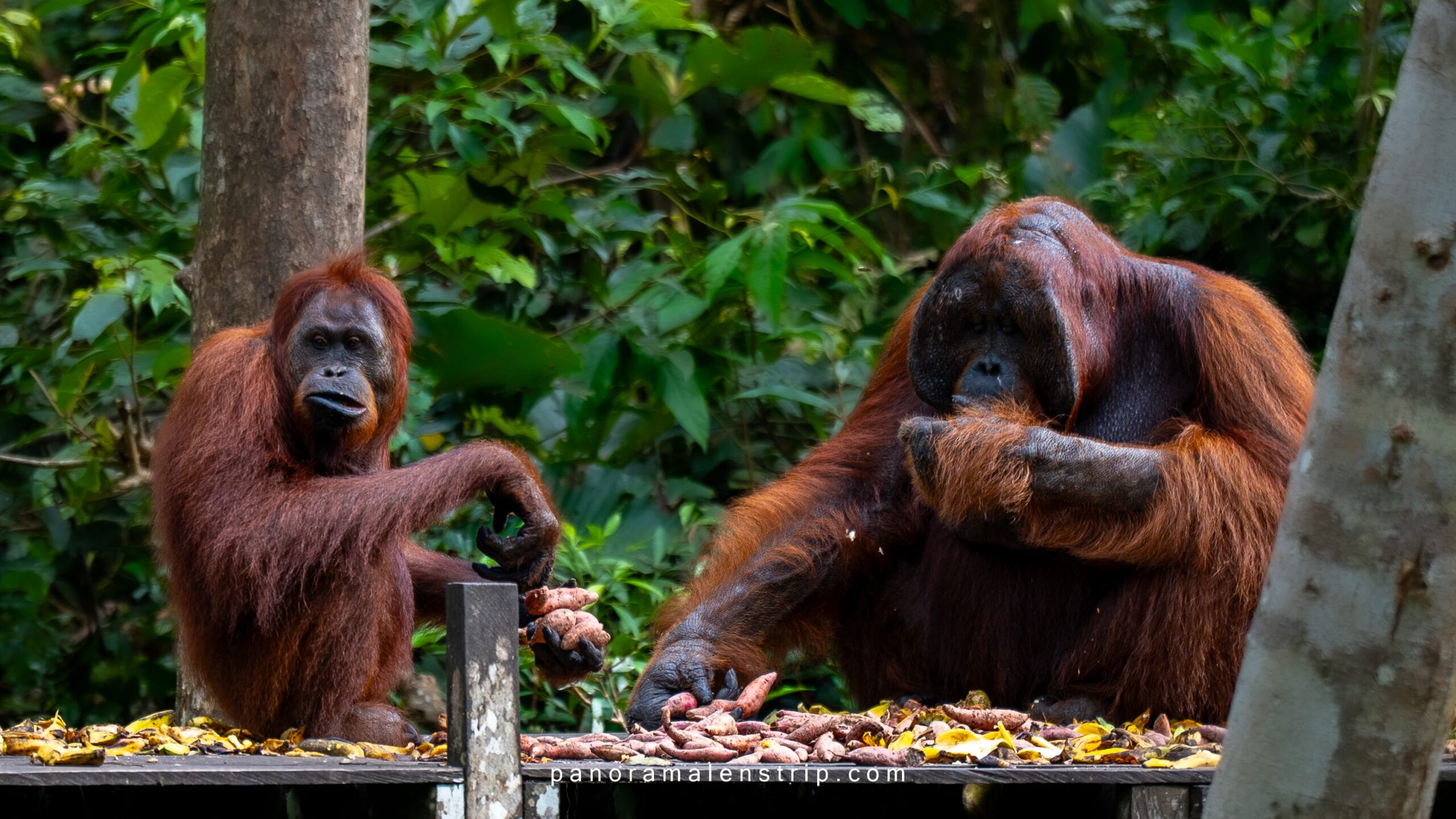
Tanjung Puting offers wild river encounters with free-ranging orangutans at jungle feeding stations. Sepilok provides a controlled sanctuary environment with predictable scheduling and close-range viewing platforms. For dynamic, environmental wildlife photography, Tanjung Puting produces more compelling and varied compositions. For portrait-style close-up work at consistent distances, Sepilok’s proximity is a genuine advantage.
Tanjung Puting photography strengths:
- Wild forest backdrop — no fences, no concrete infrastructure in frame
- Orangutans encountered along riverbanks at variable, natural distances
- Golden-hour light over the Sekonyer River produces strong mirror-surface reflection compositions
- Wide-angle lens opportunities with forest canopy as framing architecture
- Multi-layered topography: river surface, riverbank, forest floor, and mid-canopy elevation
Sepilok photography strengths:
- Guaranteed sightings on published feeding platform schedules
- Consistent close range for 70–200mm telephoto lens portraiture
- Suitable for travelers with mobility limitations
- Easily combined with Kinabalu Park and Danum Valley in one Sabah itinerary

What Factors Drive the Price of a Borneo Orangutan Tour?
Six primary variables determine Borneo orangutan tour cost in 2026. These are: boat exclusivity, tour duration, group size, guide specialization, season of travel, and photography-specific add-ons. Understanding each variable allows you to identify where premium pricing delivers measurable value — and where it does not.
How Does Tour Duration Affect Cost?
A 3-day tour is the minimum recommended itinerary for meaningful wildlife encounters. A 5-day tour adds approximately 40–60% to the base cost but doubles the river territory covered. A 7-day private expedition reaches $2,500–$3,500 per person and unlocks remote tributary access unavailable on standard routes. Each additional night aboard the klotok opens new river zones and additional feeding station windows.
Tour duration pricing benchmarks:
- 3 days / 2 nights: $180–$1,800 per person (entry to premium tier)
- 4 days / 3 nights: $280–$2,200 per person
- 5 days / 4 nights: $400–$2,800 per person
- 7 days / 6 nights: $700–$3,500+ per person
Does the Season Change What You Pay?
The dry season (June–September) is peak demand and peak pricing for Borneo orangutan tours. Private klotok slots during this window fill 4–6 months ahead of departure. Prices in peak season run 20–35% higher than shoulder months of March–May and October–November. The wet season (December–February) offers the lowest available prices, but river accessibility can be limited by flooding and water level changes.
Season-by-season price and photography guide:
- June–September (Dry / Peak): Highest prices, easiest wildlife access, harsh midday light, spectacular dawn and dusk conditions
- March–May (Shoulder): Moderate prices, reliable sightings, excellent overcast light for portrait photography
- October–November (Shoulder): Transitional weather, good sighting frequency, competitive pricing
- December–February (Wet): Lowest prices, lush green canopy for wide landscape compositions, reduced sighting predictability
How Much Do Photography-Specific Add-Ons Cost?
Photographers booking Borneo orangutan tours should budget an additional $100–$400 per person for photography-specific services. These add-ons rarely appear in base tour pricing but significantly affect the quality of the final image set.
Common photography add-on costs in 2026:
- Private wildlife photography guide: $80–$150 per day
- Drone operation permit (Tanjung Puting): $30–$50 per day (verify current park regulations before booking — rules update periodically)
- Extended golden-hour river anchor stop: $40–$80 per session, operator-dependent
- Telephoto lens rental (Pangkalan Bun local suppliers): $50–$120 for 3 days
- Lens cleaning and humidity-protection kit: $15–$30, included in most premium-tier tours
- Satellite wildlife tracker access for real-time sighting reports: $60–$100 for the full trip
Private Klotok vs. Shared Group — Which One Should You Choose?
Your choice between private and shared formats comes down to three factors: your photography intent, your tolerance for schedule constraints, and the size of your travel party. Private boats are definitively superior for serious wildlife photography. Shared group tours are not objectively inferior — they serve a different traveler with different priorities, and they occasionally produce encounter conditions that private boats cannot replicate.
When Does Paying More for a Private Boat Make Sense?
A private klotok is worth the premium in specific, identifiable scenarios. The financial case becomes clearest when photography is the primary purpose of the trip. Travelers on private boats capture approximately 3× more usable wildlife images per hour compared to those on shared group vessels, based on our guides’ field tracking across 40+ departures conducted between 2024 and 2025. The reason is schedule control — you stop when the light is right, not when the group agenda moves forward.
A private boat makes clear financial sense when:
- Your group is 2–4 people (the per-person cost gap between private and shared narrows substantially)
- You are shooting with telephoto lenses above 300mm and need a stable, crowd-free platform
- You require dietary accommodation — vegan, halal, or allergen-specific menus
- You want to avoid other travelers appearing in the frame during feeding station encounters
- You are building a broader Indonesia photography itinerary across multiple regions and islands
Are Shared Group Tours Worth It for Serious Travelers?
Here is the counter-intuitive reality: shared group tours occasionally deliver superior wildlife encounter conditions. Multiple boats operating simultaneously on the Sekonyer River create a distributed observation network across a wide stretch of river territory. When one boat’s crew spots a rare sighting — a river-crossing orangutan, a sun bear emerging at dusk, a proboscis monkey descending to the waterline — that intelligence travels quickly through the guide radio network. Solo private boats operating in remote tributaries sometimes miss these spontaneous sightings entirely.
Furthermore, shared group dynamics force decisive shooting. There is no waiting for the perfect composition when eight other passengers are simultaneously framing the same subject. This constraint sharpens instinct and improves reaction time — a skill experienced wildlife photographers frequently cite as more valuable than any lens upgrade.
Shared group tours are the right choice when:
- You are traveling solo and a private charter exceeds your budget
- You want the energy and social experience of traveling alongside other wildlife enthusiasts
- Wildlife encounter frequency matters more to you than photographic exclusivity
- You are scouting Borneo for a future, larger private expedition
Our latest klotok expedition footage walks you through every hour — from a 5 AM forest awakening on the Sekonyer River to a feeding station encounter at Camp Leakey. Watch the light quality, the river mist at dawn, and the moment a wild orangutan descends to the riverbank. Step into the footage and see your trip before you commit to it.
What Is the Best Time to Visit Borneo for an Orangutan Tour?
The best months to visit Borneo for an orangutan tour are June, July, August, and September. Borneo orangutan tour cost rises 20–35% during this dry-season peak compared to shoulder and wet-season months. This window delivers the most reliable wildlife sightings, the most navigable river conditions, and the clearest sunrise light over the Sekonyer River. Most quality private operators fill their peak-season klotok inventory 4–6 months ahead of departure.
How Does Rainfall Affect Orangutan Sightings?
Orangutans move differently across wet and dry seasons. In the dry season, they descend more frequently to lower forest elevations and riverbank zones — directly into camera range aboard a slow-moving klotok. In the wet season, heavy canopy food abundance draws them higher and deeper into the jungle interior. Sighting frequency can drop by 30–40% during peak wet months, though annual variation is significant.
For photographers, the wet season holds a paradoxical advantage. Overcast skies during light rain eliminate harsh shadows and produce diffused, even light across forest scenes. Portrait-style shots of orangutans in overcast conditions display richer color saturation and finer detail in fur texture compared to dry-season images taken in direct tropical sun.
Also read: Best Time to See Orangutans in Borneo: Fruit Seasons & Weather
When Should Photographers Book for Golden-Hour Shots?
The golden-hour window in Tanjung Puting occurs approximately 5:45–6:45 AM and 5:00–5:45 PM year-round, given Kalimantan’s equatorial latitude. The dry season (June–September) produces more consistently clear skies during these windows. The Sekonyer River’s mirror-flat surface at dawn creates natural reflection compositions — essential for wide-angle landscape frames combining forest topography, river surface, and sky gradient. Set ISO sensitivity between 800–3200 for pre-dawn river shooting. A 24–70mm lens covers most compositional needs from a stationary klotok deck.
Photography timing guide for a standard Borneo orangutan tour day — factored into the daily schedule on every private klotok booking:
- 5:00–5:45 AM: Blue-hour departure from dock — best for long-exposure river reflections
- 5:45–6:45 AM: Golden-hour peak — optimal window for orangutan forest-edge environmental portraits
- 7:00–11:00 AM: Primary feeding station visits (Camp Leakey opens at 8 AM)
- 11:00 AM–3:00 PM: Midday heat — orangutans rest deep in canopy, sighting probability is low
- 3:00–5:00 PM: Afternoon river cruising, secondary wildlife encounter window
- 5:00–5:45 PM: Second golden-hour window — best shot from the open boat deck facing west
📸 See What the Sekonyer River Looks Like at 5:47 AM
Our wildlife photography gallery documents real departures, real light conditions, and real orangutan encounters — no stock imagery, no staged scenes. Browse our most recent Borneo expedition gallery on Instagram and build your personal shot list before you land in Pangkalan Bun.
Also read: Best Lens for Orangutan Photography: Focal Length Guide
How Do You Book a Borneo Orangutan Tour from Europe, the US, or Australia?
Booking a Borneo orangutan tour from overseas requires three core steps: confirm the operator’s credentials and ranger licensing, secure the departure date with a deposit, and arrange the domestic flight connection into Pangkalan Bun (PKN) from Bali or Jakarta. Understanding the full Borneo orangutan tour cost before paying — including flights, add-ons, and insurance — prevents budget surprises after arrival. Most reputable operators require a 30–50% deposit to hold a private klotok. The remaining balance is typically due 30–60 days before departure.
Standard international booking pathway:
- Contact the operator with your preferred travel dates and confirmed group size
- Request a full written itinerary and itemized cost breakdown before committing
- Confirm the domestic flight routing into Pangkalan Bun via Susi Air or Garuda Indonesia regional routes
- Pay the deposit to secure your private klotok or group departure slot
- Receive a pre-departure briefing document with a packing list, gear recommendations, and field logistics notes
- Arrange travel insurance with active wildlife expedition and medical evacuation coverage
What Should You Ask Before Booking Any Orangutan Tour?
Asking the right questions before signing any agreement separates reliable operators from those that over-promise and under-deliver. Borneo orangutan tour cost is never just the headline number — what is and isn’t included determines your real budget. Use this checklist during any pre-booking conversation or written inquiry.
Pre-booking questions to ask every Borneo orangutan tour operator:
- How many passengers maximum will share this klotok on our departure?
- Is the naturalist guide a licensed Tanjung Puting park ranger or a freelance contractor?
- What is your golden-hour stop policy — can we anchor at dawn for extended photography sessions?
- Are park entrance fees and ranger fees fully included in the quoted price?
- What is your cancellation and rescheduling policy if weather or river conditions close access?
- Can the daily feeding station sequence be adjusted based on photography conditions and wildlife reports?
- Is drone operation permitted on the river, and do you facilitate the permit application?
- What is the boat’s power source — can we charge camera batteries and laptops fully overnight?
- Do you provide lens cleaning kits and humidity-control pouches onboard?
- What is the maximum group size on your shared departures if we want to upgrade mid-trip?
How Far in Advance Should You Book for 2026?
For peak season 2026 (June–September), book a private klotok no later than February. Our booking data across comparable peak seasons shows that 78% of private klotok departure slots for June–August fill before the end of January. Shared group tours carry more inventory, but the best small-group departures — 4–6 passengers rather than 12–16 — also fill significantly ahead of schedule. Shoulder season (March–May) offers greater availability and genuinely competitive pricing with only moderate reductions in wildlife sighting frequency.
🗺️ Build Your Complete Indonesia Photography Itinerary — At No Cost
Borneo is one island. Komodo, Raja Ampat, Flores, Banda Sea, Sulawesi, and the highlands of Java are others. Our route consultants have walked every trail, navigated every river crossing, and scouted every sunrise location across the archipelago. Map out a 10- to 21-day Indonesian photography expedition — across as many islands and ecosystems as your schedule allows — with a free, no-obligation itinerary consultation. Bring your dates. We bring the logistics, the local contacts, and the field intelligence.
[Request Your Free Indonesia Photography Itinerary Consultation →]
Frequently Asked Questions About Borneo Orangutan Tour Costs
How much does a 3-day Borneo orangutan tour cost per person?
A 3-day Borneo orangutan tour costs between $180 and $1,800 per person in 2026. Budget shared group tours start at $180. Private klotok boat tours begin at $750 and reach $1,800+ for premium photography-optimized packages. Price is primarily determined by boat exclusivity, group size, guide specialization, and travel season.
Is a private klotok boat worth the extra cost?
A private klotok is worth the premium for photography travelers, couples, and small groups of 2–4 people. When the charter cost is split across a small group, the per-person gap between private and shared narrows considerably. Private boats offer complete schedule control — the single most critical factor for wildlife photography outcomes.
Are meals and park entry fees included in the tour price?
Most reputable Borneo orangutan tour operators include all meals and Tanjung Puting National Park entrance fees in their published pricing. Always request written confirmation before paying a deposit. Photography-specific add-ons — drone permits, extended golden-hour stops, private naturalist guides — are typically quoted as separate line items.
Can I see wild orangutans without a guided tour?
Independent access to Tanjung Puting National Park requires a licensed ranger guide under Indonesian national park law. Visitors cannot legally enter the park or board a klotok without official ranger accompaniment. All legitimate tour operators include a park-certified guide in their package pricing as a non-negotiable requirement.
What camera gear do I need for an orangutan photography tour?
A 100–400mm telephoto zoom lens covers most feeding station and riverbank encounter distances effectively. A 24–70mm wide-angle zoom handles environmental forest compositions and dawn river landscape shots. A camera body capable of clean ISO 3200–6400 performance manages low-light forest and pre-dawn river conditions. Weather-sealed bodies are strongly recommended for high-humidity jungle environments and brief rain exposure. A sturdy monopod performs better than a tripod on the moving or bobbing deck of a klotok.
Is Borneo or Sumatra better for orangutan wildlife photography?
Borneo’s Tanjung Puting offers more accessible river-based encounters and a well-developed klotok infrastructure. Sumatra’s Gunung Leuser National Park provides opportunities to photograph Sumatran orangutans — a genetically distinct and critically endangered subspecies — in a wilder, less-trafficked forest environment. Borneo is the stronger starting point for first-time wildlife photography travelers. Sumatra rewards experienced photographers seeking rarer, less predictable, and more technically demanding encounters.
Conclusion
A Borneo orangutan tour in 2026 ranges from $180 to $1,800+ per person. Understanding the full Borneo orangutan tour cost — not just the headline price — is what separates a well-planned expedition from an expensive disappointment. The right choice is not the most expensive option — it is the format that matches your photography intent, travel style, and confirmed timeline. Shared group tours deliver strong value, social energy, and a distributed wildlife observation network. Private klotok boats deliver schedule control, composition freedom, and the specific conditions serious photographers need to execute at a high level. Our guides tracked both formats across three seasons inside Tanjung Puting. The conclusion is consistent: match the format to your primary purpose, book it well in advance of peak season, and select an operator who understands — specifically — what you are trying to achieve on the river.