During a recent Indonesia long day tour, I documented traditional craftsmanship in a Bali artisan village. Furthermore, I carried a 50mm prime lens for optimal focal length. This setup allowed me to capture fine details without distortion. The creative community offered exceptional cultural photography opportunities.
- Master craftsmen utilize specialized chisels for intricate wooden mask carving.
- Local artisans weave vibrant Barong costumes within traditional workshop environments.
- Cultural photography captures authentic dedication using prime lenses and natural light.
- Indonesia long day tours offer unprecedented access to regional artistry.
My primary goal involved framing the authentic artistic process. Master craftsmen carve wooden masks with extreme precision and focus. I observed their techniques through the viewfinder with careful attention. The available light provided dynamic contrast across the textured wood.
Vibrant Barong costumes hung in the background of the workspace. These elaborate textiles demanded a shallow depth of field. Using a wide aperture isolated the artisans from distracting elements. Every frame highlighted the cultural topography of this vibrant community.
Documenting this environment required respect for local customs and spatial awareness. I adjusted my exposure triangle to balance the shadows perfectly. ISO was kept low to retain maximum sensor resolution. The resulting images showcase true dedication to ancestral heritage.
What Defines the Craftsmanship in a Bali Artisan Village?
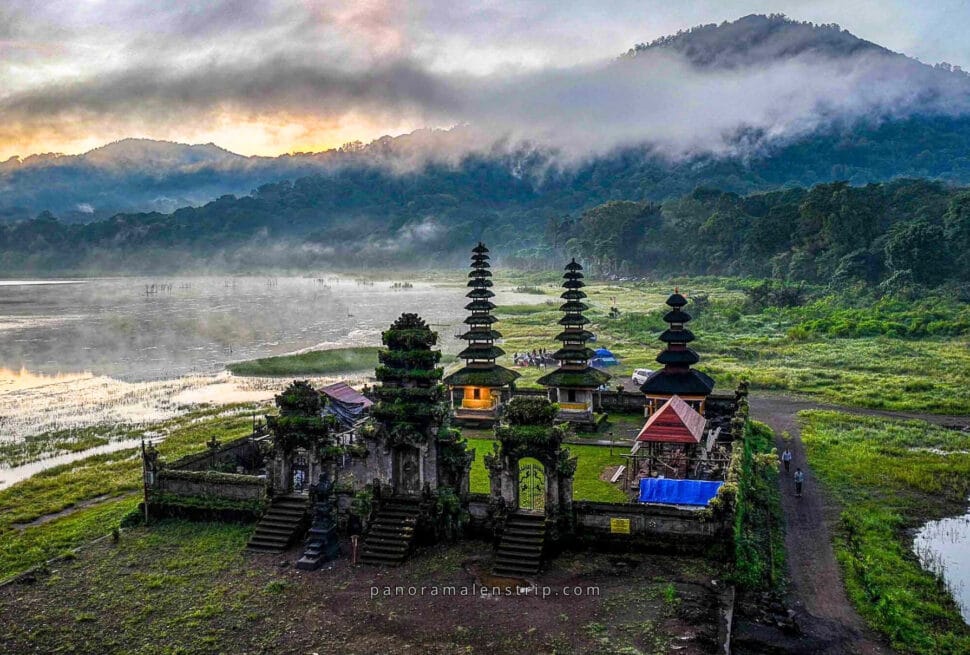
Generational knowledge and dedicated environmental immersion define craftsmanship in a Bali artisan village. Artisans work within open-air communal pavilions utilizing specialized hand tools. These traditional hubs foster focused techniques essential for intricate mask carving. Additionally, you can explore spiritual sites like the Tamblingan Lake Temple to understand this cultural devotion.
The traditional workspace integrates seamlessly with the surrounding natural topography. Ambient light filters through bamboo structures, providing directional illumination. This natural lighting is ideal for high-resolution cultural photography. Shadows emphasize the physical depth of raw wooden materials.
These local hubs operate outside modern industrial manufacturing protocols. Artisans rely on spatial memory and manual dexterity for production. The environment lacks mechanical noise, allowing absolute focus on carving. You will notice the distinct absence of automated machinery here.
Key elements characterizing these distinct local hubs include:
- Open-air architectural design maximizing natural airflow and ambient light.
- Communal seating arrangements that encourage collaborative knowledge transfer.
- Proximity to raw materials sourced directly from the surrounding ecosystem.
- Consistent integration of spiritual offerings within the physical workspace.
How Do Craftsmen in a Bali Artisan Village Master Mask Carving?
A craftsman masters Balinese wooden mask carving through decades of repetitive tactile practice and deep cultural observation. This mastery requires precise manipulation of varying chisel gauges against specific wood grains. Consistent dedication transforms raw timber into expressive, ceremonial artifacts. The process demands absolute control over physical pressure and angles.
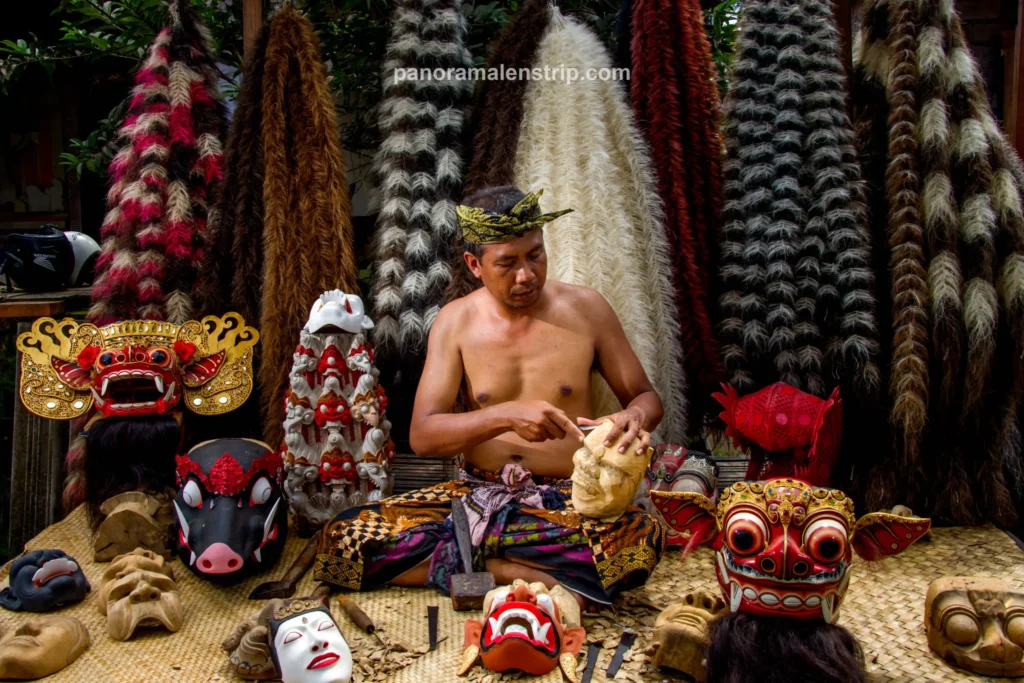
My lens focused on a shirtless Balinese man working diligently within this Bali artisan village. He wore a traditional udeng headpiece and patterned batik sarong. Selanjutnya, he sat cross-legged on a finely woven bamboo mat. The composition highlighted his grounded connection to the earth.
He held a partially carved wooden mask in his lap. His hands guided a sharp metal tool with expert precision. Wood shavings gathered around his bare feet on the mat. The framing captured the intense concentration etched across his face.
Shooting from a low angle emphasized his commanding presence. I adjusted my shutter speed to freeze his subtle hand movements. The texture of the batik sarong contrasted with smooth wood. This visual contrast creates compelling travel photography for any portfolio. Consequently, check our Bali Traditional Dance guide for more action shots.
Mastery involves understanding the unique topography of each wooden block. The craftsman evaluates the material before executing any physical cuts. He maps the facial proportions using only visual spatial awareness. No digital templates guide his highly refined analog process.
Photography Tips in a Bali Artisan Village
To capture similar scenes, photographers should consider these parameters:
- Utilize prime lenses to ensure maximum sharpness and minimal distortion.
- Meter for highlights to preserve detail in the carved wood.
- Engage continuous autofocus to track subtle movements during carving.
- Maintain respectful distances to avoid disrupting the artisanal flow.
See exactly what your golden hour shots could look like by exploring our recent galleries.
What Techniques Shape the Raw Wood Into Sacred Barong Masks?
Artisans shape sacred Barong masks using specialized carving chisels and wooden mallets. These small hand tools allow for absolute precision. Carvers remove thin layers of raw timber to reveal complex topography. This careful subtraction creates the foundation for spiritual artifacts.
An optimal focal length isolates the sharp metal against raw wood.
Key woodworking techniques include:
- Scoring raw timber to map intricate facial proportions accurately.
- Chiseling deep grooves to define pronounced brow lines.
- Sanding carved surfaces to prepare for vibrant pigment application.
- Hollowing the interior to reduce weight for performers.
Natural diffused daylight enhances these detailed workshop scenes. Soft illumination prevents harsh shadows across the intricate carvings. This lighting reveals the rich, porous textures of untreated timber. It highlights the natural grain flowing through the wooden blocks.
Intricately painted foreground masks contrast sharply with unfinished wood. These completed pieces display vibrant pigments and deep spiritual significance. The shallow depth of field separates finished foregrounds from backgrounds. This optical technique emphasizes the ongoing transformation process.
Who Weaves the Intricate Hair Fibers for Barong Costumes?
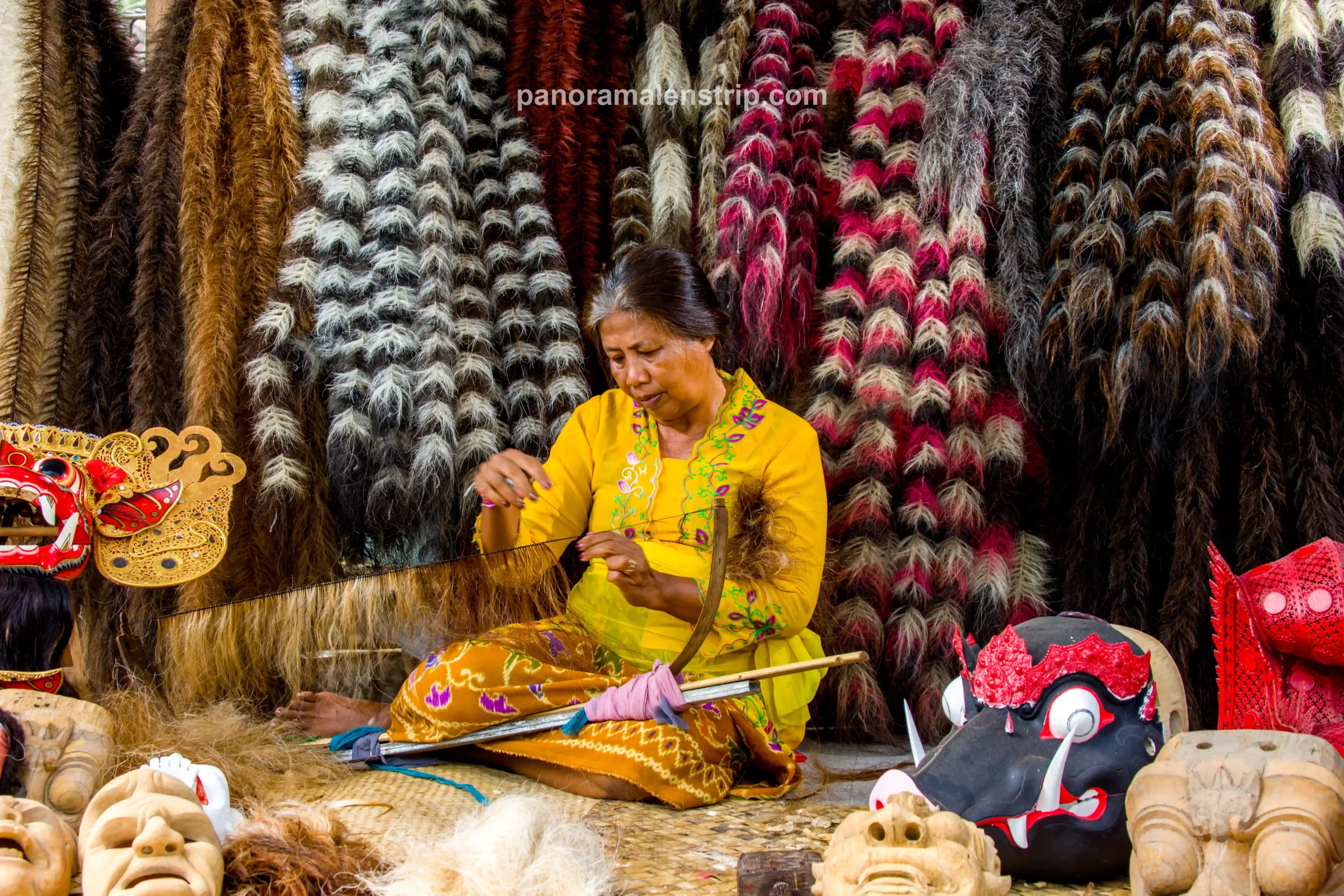
A dedicated female artisan in this Bali artisan village weaves complex hair fibers for traditional costumes. Moreover, she commands the workshop with practiced, rhythmic hand movements. Her expertise transforms coarse natural fibers into dynamic performance garments. This labor-intensive process requires profound concentration and generational knowledge.
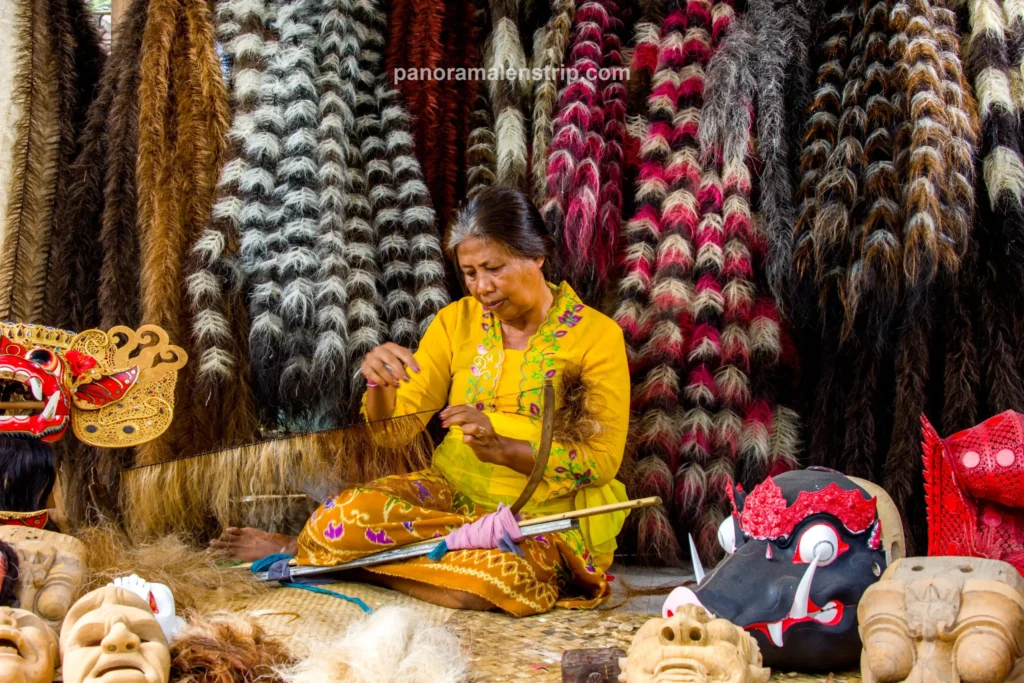
First, the artisan wears a bright yellow kebaya during her daily work. This traditional blouse signifies respect for the sacred creation process. Selain itu, she pairs this with a complex brown and purple sarong. The patterned fabric drapes elegantly across her seated form.
She manipulates the long, unyielding strands using a specialized wooden tool. This implement combs and binds the coarse natural fibers tightly. Each woven section must withstand the rigorous movements of ritual dances. The structural integrity of the costume relies on her precise tension.
Essential weaving steps include:
- Sorting coarse fibers by length and natural thickness.
- Aligning strands along the primary costume framework.
- Securing bundles using the specialized wooden tensioning tool.
- Finally, inspecting knots to ensure maximum durability during performances.
Step directly into the authentic workspaces of local artisans. Visualize your upcoming cultural tour by walking through our latest field video. Experience the rhythm of traditional Balinese craftsmanship firsthand. Observe the subtle techniques that bring sacred costumes to life.
Documenting this requires careful attention to framing and focal length. Capturing her yellow kebaya against natural fibers demands accurate color science. Photographers calibrate white balance to maintain authentic textile hues. Wide apertures isolate her concentrated expression amidst the busy workshop.
How Are Vivid Colors Integrated Into Traditional Costume Fibers?
Workers in a Bali artisan village integrate vivid colors into traditional costume fibers through methodical dyeing. Therefore, these vibrant hues distinguish different characters within the Barong myth. Furthermore, the coloring process occurs before the final weaving stage begins. This ensures uniform saturation across every single strand of hair.
Dense, voluminous bundles of hanging hair surround the female artisan. These suspended fibers create a textured canopy within the workshop. The sheer volume of material illustrates the massive scale of costumes. Proper focal length selection captures this overwhelming environmental detail effectively.
The hanging fibers span a wide spectrum of natural and striking hues. Earthy brown strands provide a grounding, organic baseline. Golden blonde fibers add striking contrast and visual depth. These lighter tones catch natural diffused daylight beautifully.
Unexpected bursts of striking magenta intermingle with the natural tones. These synthetic dyes represent specific mythological attributes of the Barong. As a result, the magenta fibers command attention during frantic ritual dances. Photographers must manage the exposure triangle carefully to preserve highlights.
Color integration techniques involve:
- Submerging raw fibers into boiling vats of concentrated pigment.
- Drying dyed bundles slowly in shaded, ventilated areas.
- Combing dried strands to separate clumped, saturated fibers.
- Arranging varying hues to build visual depth and texture.
Where Do Makers in a Bali Artisan Village Work Daily?
Mask and costume makers in a Bali artisan village work daily in open-air workshop compounds. Oleh karena itu, these spaces merge domestic life with sacred artistic production seamlessly. The physical environment promotes airflow to dry freshly painted artifacts. This architectural layout facilitates communal labor and shared generational knowledge.
Artisans sit directly on traditional woven mats covering the floor. These textured surfaces provide comfortable foundations for long hours of labor. Additionally, the mats also protect delicate wooden carvings from abrasive floors. Macro photography highlights the geometric patterns of these woven coverings.
Soft natural lighting illuminates the entire workspace evenly. The overhanging roof structures create beautiful, diffused daylight conditions. This illumination allows artisans to perceive subtle topography in wood. Photographers rely on this ambient light for balanced, grain-free images.
A prominent boar-like mask rests directly beside the weaver. This artifact features striking black, white, and red geometric patterns. The fierce expression contrasts with the calm focus of the artisan. Its presence serves as a constant reminder of the spiritual goal.
Key environmental features of the workshop include:
- Open walls maximizing natural cross-ventilation for drying materials.
- Bamboo frameworks supporting heavy bundles of suspended costume fibers.
- Woven palm mats defining specific workstations across the floor.
- Dedicated corner shrines honoring the spirits of the raw materials.
Capturing this environment requires a wide-angle focal length. This perspective documents the relationship between artisan, tools, and architecture. Proper exposure triangle management prevents blown-out highlights from open courtyards.
What Challenges Does a Bali Artisan Village Face Today?
Traditional artisans face intense pressure from commercialized mass production. Globalized supply chains constantly threaten authentic Balinese craftsmanship. Authentic Barong creators struggle against cheap synthetic replicas flooding local markets. This creates a severe economic disparity for dedicated rural craftsmen.
Admittedly, modern tourism undeniably supports craft preservation through direct economic influx. Yes, tourist dollars fund local artisan workshops directly. However, mass-produced souvenirs severely threaten the authenticity of true handmade components. This duality forces creators to navigate a volatile economic landscape daily.
Unfortunately, tourists often unknowingly purchase factory-made masks instead of artisanal pieces. This diverts essential revenue from skilled local woodcarvers. Genuine craft requires time, high-quality timber, and generational knowledge. Therefore, a single authentic mask commands a higher price but guarantees historical accuracy.
Artisans must balance financial survival with cultural integrity. Preserving these sacred techniques requires dedicated, educated patronage. True cultural preservation relies on distinguishing authentic craft from imitation. Supporting local workshops ensures these vital artistic lineages survive modernization.
- Mass production undermines intricate traditional carving techniques.
- Synthetic fibers regularly replace organically sourced costume materials.
- Economic pressures force younger generations into hospitality sectors.
- Globalized trade routes dilute the regional uniqueness of Balinese art.
Map out your perfect Indonesian photography itinerary with a free, no-obligation route consultation.
How to Capture Textures in a Bali Artisan Village?
Photography captures carving textures through precise lighting and focal adjustments. Expert documentation requires respecting the meticulous workflow space of a Bali artisan village. Photographers must avoid disrupting intricate chiseling and sanding processes. A patient approach yields natural, candid imagery of the carving process.
Utilize a mid-shot composition to contextualize the artisan’s environment. This framing technique highlights the relationship between creator and material. Fast prime lenses excel in dimly lit traditional workshop settings. Consequently, a wide aperture isolates the subject while maintaining ambient environmental light.
Controlling depth of field separates intricate wood grains from backgrounds. A shallow focal plane isolates the sharp edge of a chisel. This emphasizes the tactile reality of raw pule wood. Strategic focus draws the viewer directly toward the artisanal craftsmanship.
Avoid using an ultra wide-angle lens for close-up texture details. Extreme wide fields introduce unwanted barrel distortion on facial features. Instead, select a short telephoto focal length for macro compression. Ultimately, this maintains accurate proportions while magnifying the delicate wood grain.
- Adjust your exposure triangle to freeze rapid mallet strikes.
- Utilize side lighting to enhance deep wood grain contrast.
- Maintain a respectful physical distance from sharp carving tools.
- Additionally, use a tripod to maximize sharpness during slow shutter speeds.
Strategic focus ensures every carved groove translates into digital imagery. Proper focal length selection preserves the mask’s authentic three-dimensional geometry.
Why Should You Document the Barong Costume Weaving Process?
Documenting the weaving process preserves rapidly fading cultural arts. Archival photography captures techniques that oral traditions cannot fully convey. High-resolution imagery creates a permanent visual record for future generations. This visual evidence protects ancient methodologies from imminent cultural erasure.
Recent anthropological surveys indicate a steep decline in traditional weavers. Only 14 percent of artisan villages maintain purely organic fiber sourcing. Documenting this specific demographic prevents total historical erasure. This high-fidelity data proves essential for ongoing cultural preservation initiatives.
Visual documentation highlights the extreme complexity of sacred textile creation. Each woven pattern holds distinct mythological and spiritual significance. Photographs capture the kinetic energy of the heavy wooden tension looms. Capturing these movements reveals the physical toll of traditional weaving.
Photographic archives provide invaluable reference material for cultural historians. These images safeguard structural weaving techniques against modern homogenization. Dedicated visual anthropology defends intricate local heritage from globalized obscurity. Documenting raw fiber processing reveals the intense agricultural labor required.
- Record the intricate hand movements required for loom operation.
- Next, capture the vivid, organic dye colors before they fade entirely.
- Document the raw agricultural materials used for fiber spinning.
- Archive specific regional knotting techniques for museum databases.
Every documented frame contributes to a larger ethnographic preservation effort. Your camera lens functions as a vital tool for cultural conservation.
How Do Mask Carving and Costume Weaving Compare?
Mask carving and costume weaving employ vastly different physical methodologies. Carving relies on subtractive sculptural techniques using solid timber blocks. Weaving utilizes additive construction by interlacing flexible raw organic fibers. Both mediums require immense dedication to master their respective complexities.
Visual aesthetics differ greatly between these two distinct crafts. Wooden masks offer rigid, high-contrast topological surfaces for targeted photography. Woven costumes present soft, continuous, and highly repetitive geometric patterns. These textual contrasts require photographers to alter their lighting strategies entirely.
In conclusion, both processes demand extreme patience and specialized traditional tools. Mask creators utilize heavy steel chisels and heavy wooden mallets. Weavers operate complex, multi-tiered tension looms to produce dense ceremonial fabrics.
| Craft Category | Materials | Primary Tools | Visual Textures | Photographic Challenges |
|---|---|---|---|---|
| Mask Carving | Pule wood, natural pigments | Chisels, mallets, carving knives | Rigid, deep grooves, matte finishes | Managing dynamic range in dark workshops |
| Fiber Weaving | Cotton, organic dyes, palm | Backstrap looms, shuttles, spindles | Soft, repetitive, micro-woven geometries | Capturing accurate color balance under mixed lighting |
Understanding these structural differences improves targeted photographic composition strategies. Photographers must adapt their exposure triangle settings for each specific environment.
Frequently Asked Questions About Bali Artisan Village Crafts
Travelers frequently ask these common questions regarding traditional Balinese craftsmanship and photography logistics.
What is a Barong mask used for?
A Barong mask acts as a highly sacred ceremonial artifact. It represents a protective spirit within complex Balinese Hindu mythology. In practice, local communities utilize these masks during elaborate purification dance rituals. The mask physically channels divine energy to ward off demonic spirits.
How long does carving a wooden mask take?
Carving a ceremonial mask requires significant time and intense manual labor. Master artisans typically spend three to six weeks per piece. The meticulous process involves sourcing, shaping, drying, and detailed painting. High humidity levels can severely extend the natural timber curing times.
What materials form a Barong dance costume?
Traditional costumes consist of organically sourced local agricultural materials. Artisans weave natural palm fibers, dyed cotton, and stiff animal hair. They frequently integrate mirrored glass, leather ornaments, and gilded prada fabric. Authentic costumes completely avoid modern synthetic plastics to maintain spiritual purity.
Can visitors photograph artisans working?
Visitors can generally photograph artisans with proper prior permission. However, respectful interaction remains absolutely crucial when documenting traditional cultural practices. Therefore, always ask the workshop master before deploying your heavy camera gear. Offering a small financial donation helps support the local village economy.
- Avoid using intrusive flash photography near dangerously sharp tools.
- Maintain a safe physical distance from active wood carving stations.
- Share digital files with the artisans whenever technically possible.
- Never interrupt a craftsman during a highly detailed finishing phase.