
What Is Borobudur Temple and Why It Matters
Definition and Global Recognition
Borobudur Temple is the largest Buddhist monument in the world and one of Indonesia’s most important cultural landmarks. Built in the 8th–9th century, it stands as a masterpiece of ancient architecture and religious art. The history of Borobudur Temple reflects the advanced civilization that once thrived in Central Java. Its scale, detail, and philosophical depth have earned global recognition. In 1991, UNESCO officially listed Borobudur Temple as a World Heritage Site, confirming its universal value. Today, people admire it not only as a historical structure but also as evidence of human creativity and spiritual expression that transcends borders.
Borobudur as a Spiritual Monument
Borobudur Temple was designed as a spiritual journey rather than a conventional place of worship. Pilgrims walk clockwise around each level, gradually ascending toward enlightenment. This ritual movement symbolizes the human path from desire to wisdom. In the history of Borobudur Temple, this concept makes it unique among religious monuments, blending meditation, education, and architecture into a single sacred experience.
Geographic Setting of Borobudur Temple
Location in Central Java
Borobudur Temple is located in Magelang, Central Java, Indonesia. It sits in a fertile valley surrounded by rivers and ancient trade routes. This strategic location supported religious activities and community life. The history of Borobudur Temple is closely tied to this region, which was once a major center of Buddhist learning and political power.
Volcanic Landscape and Symbolism
Volcanoes such as Mount Merapi, Merbabu, and Sumbing frame the temple. Ancient belief systems regarded these natural features as sacred. Volcanic soil also provided strong stone material. In the history of Borobudur Temple, the surrounding landscape reinforces harmony between nature, spirituality, and human creation.
Origins of Borobudur Temple
The Sailendra Dynasty
Borobudur Temple was commissioned by the Sailendra Dynasty, a powerful Buddhist ruling family in Java. They supported Mahayana Buddhism and invested heavily in religious monuments. The history of Borobudur Temple reflects their devotion and political influence, using architecture to express faith and authority.
Timeline of Construction
Construction likely began around 780 CE and continued for several decades. Thousands of artisans worked without modern tools or cement. Stones were interlocked with precision. This long process highlights the ambition behind the history of Borobudur Temple and the advanced planning of its builders.
Architectural Design and Structure
Mandala Concept
Borobudur Temple takes the form of a giant mandala, representing the Buddhist universe.. Each level symbolizes a stage of consciousness. The design guides pilgrims upward, physically and spiritually. This concept is central to the history of Borobudur Temple and its philosophical meaning.
Terraces, Stupas, and Reliefs
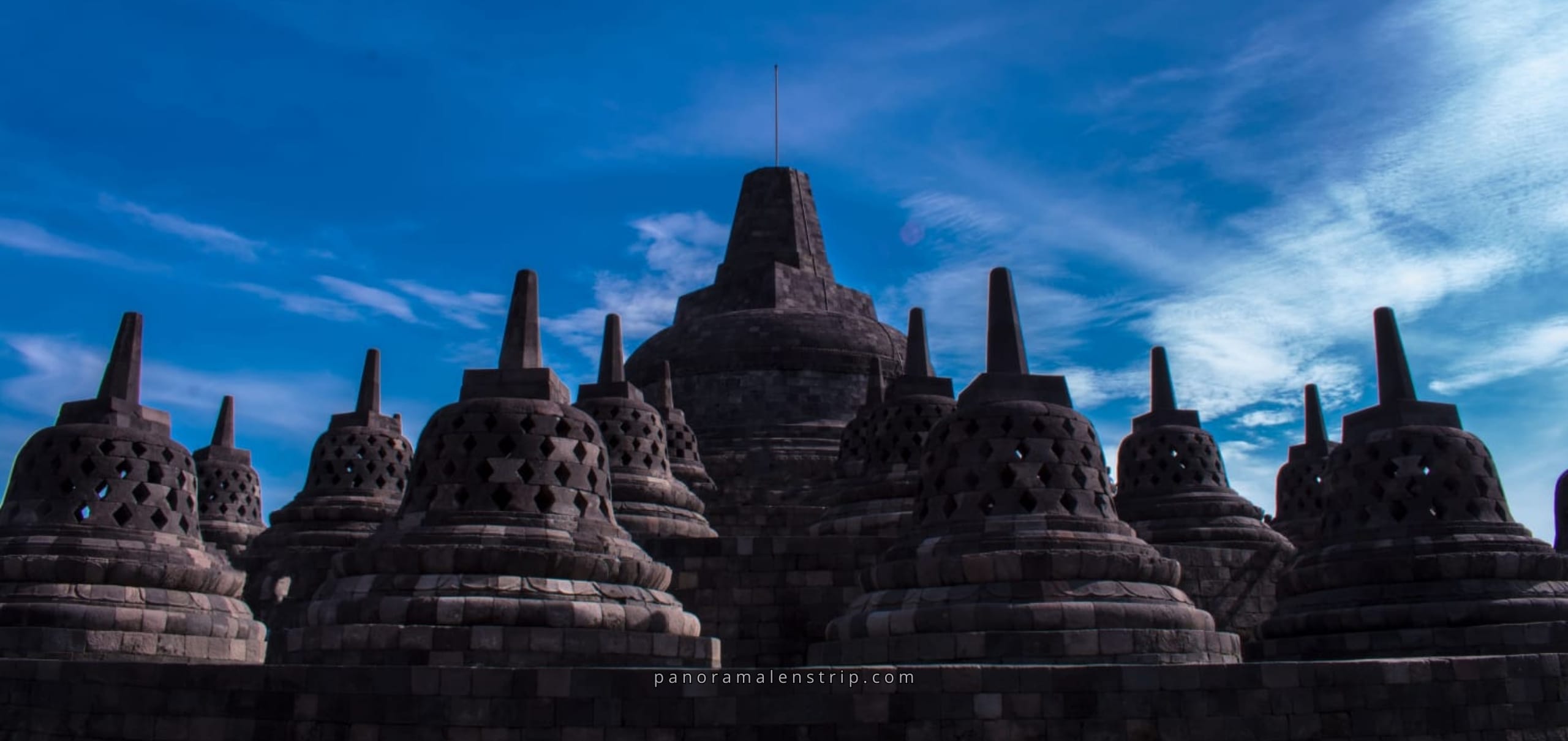
The monument has nine stacked platforms, crowned by a central stupa. More than 2,600 relief panels and 504 Buddha statues decorate the structure. These elements combine storytelling and symbolism. They make the history of Borobudur Temple readable through stone.
Materials and Engineering Methods
Builders used volcanic andesite stone, cut and assembled without mortar. Advanced drainage systems prevent water damage. These techniques explain why the history of Borobudur Temple has survived for over a thousand years.
Symbolism in Borobudur Temple Reliefs
Buddhist Cosmology
The reliefs illustrate Buddhist teachings, including karma, rebirth, and enlightenment. The lower levels depict worldly desire, while upper levels represent spiritual purity. In the history of Borobudur Temple, this layered symbolism turns architecture into philosophy.
Life Lessons Carved in Stone
Scenes of daily life, compassion, and moral choices appear throughout the carvings. These lessons aimed to educate pilgrims. Pilgrims not only see the history of Borobudur Temple—they learn it step by step through its stone narratives.
Religious Function of Borobudur Temple
Pilgrimage Rituals
Borobudur Temple was created as a sacred pilgrimage site rather than a traditional indoor temple. Devotees followed a ritual path that guided them clockwise around each level while slowly ascending. This journey symbolized the transition from worldly desire to spiritual enlightenment. In the history of Borobudur Temple, the act of walking itself was a form of meditation. Pilgrims reflected on the relief carvings, which illustrated Buddhist teachings and moral lessons. Each step encouraged mindfulness, patience, and self-awareness, making the pilgrimage both a physical and spiritual experience.
Vesak Celebrations
Today, Borobudur Temple remains central to Vesak, the most important Buddhist festival. The celebration honors the birth, enlightenment, and death of the Buddha. Thousands of monks and worshippers gather at the site, continuing the religious role preserved throughout the history of Borobudur Temple.
Daily Life Around Borobudur in Ancient Times
Monks, Artisans, and Local Society
In ancient times, Borobudur Temple was surrounded by a lively community. Monks lived nearby, teaching Buddhist philosophy and guiding pilgrims. Skilled artisans carved reliefs and maintained the structure. Farmers and traders supported daily needs. The history of Borobudur Temple shows that it was not isolated but deeply connected to local society, blending spiritual practice with everyday life.
Decline and Abandonment of Borobudur Temple
Volcanic Eruptions
Borobudur Temple began to decline around the 14th century. Frequent volcanic eruptions, especially from Mount Merapi, covered the area in ash. Over time, layers of debris buried parts of the monument. In the history of Borobudur Temple, nature played a major role in its disappearance from public memory.
Shift of Political Power
Political and religious centers moved eastward in Java. As Buddhism declined and new powers emerged, Borobudur lost its importance. The temple was eventually abandoned, hidden by jungle growth and silence.
Rediscovery of Borobudur Temple
Sir Thomas Stamford Raffles
Borobudur Temple was rediscovered in 1814 during British rule in Java. Sir Thomas Stamford Raffles ordered its excavation after hearing local reports. This marked a turning point in the history of Borobudur Temple, bringing it back into global awareness.
Early Restoration Attempts
Initial restoration efforts focused on clearing vegetation and stabilizing structures. Although limited, these attempts prevented further damage. They laid the foundation for later preservation and renewed appreciation of the history of Borobudur Temple.
Major Restoration Projects
UNESCO Involvement
The most significant restoration in the history of Borobudur Temple took place between 1973 and 1983 with UNESCO’s leadership. This international project involved experts from many countries. Workers dismantled, cleaned, and precisely reassembled millions of stones. They installed modern drainage systems to protect the structure from water damage. This effort saved Borobudur from further deterioration and restored its original form. UNESCO’s involvement marked a new chapter in the history of Borobudur Temple, transforming it into a protected global treasure.
Preservation Challenges
Despite restoration success, challenges remain. Weather, earthquakes, and volcanic ash threaten the monument. Heavy visitor traffic also causes wear. Preservation teams continuously monitor conditions. These ongoing efforts ensure the history of Borobudur Temple is protected for future generations.
Borobudur Temple as a UNESCO World Heritage Site
Criteria and Global Value
Borobudur Temple was designated a UNESCO World Heritage Site in 1991. It met criteria for cultural significance, architectural excellence, and spiritual meaning. The monument represents a peak of human creativity and religious expression. In the history of Borobudur Temple, this recognition confirms its importance beyond national borders.People value it as a shared heritage of humanity, symbolizing peace, wisdom, and artistic achievement.
Cultural and Spiritual Meaning Today
Indonesian Identity
Borobudur Temple is a source of national pride for Indonesia. It reflects centuries of cultural tolerance and creativity. The history of Borobudur Temple strengthens Indonesia’s identity as a land of diverse beliefs and traditions.
Global Buddhist Community
For Buddhists worldwide, Borobudur remains sacred. Pilgrims visit to meditate and celebrate Vesak. The history of Borobudur Temple continues through living spiritual practices that connect past and present.
Borobudur Temple and Tourism
Visitor Experience
Visitors experience Borobudur through guided paths, sunrise views, and storytelling reliefs. Walking the temple offers insight into the history of Borobudur Temple and its spiritual meaning.
Sustainable Tourism Efforts
Authorities limit visitor numbers and enforce conservation rules to protect the site. Sustainable tourism ensures the history of Borobudur Temple remains intact while still welcoming global travelers.
Borobudur Temple vs Angkor Wat
Architecture Comparison
Borobudur Temple and Angkor Wat are two of Southeast Asia’s greatest monuments, yet their designs differ greatly. Borobudur is a massive stone mandala shaped as a stepped pyramid, intended for walking as a spiritual journey. Angkor Wat, in contrast, is a sprawling temple complex with towers and galleries. In the history of Borobudur Temple, simplicity and symbolism guide the design, while Angkor Wat emphasizes scale, symmetry, and grandeur.
Religious Differences
Borobudur Temple follows Mahayana Buddhism and emphasizes enlightenment through meditation. Angkor Wat originally served Hinduism before later adopting Buddhist practices. These differences highlight how belief systems shaped each monument’s purpose and layout.
Common Myths and Misconceptions
Legends vs Facts
One common myth suggests Borobudur Temple was a royal palace or fortress. Historical evidence shows it was a spiritual monument, not a residence. Another misconception claims it was never completed. In reality, builders made the structure fully functional before abandoning it. Legends often intertwine with Borobudur Temple’s history, but archaeological research clarifies the facts, allowing visitors to appreciate its true meaning.
How to Visit Borobudur Temple Respectfully
Dress Code and Etiquette
Visitors should dress modestly, covering shoulders and knees. Climbing restricted areas is not allowed. Quiet behavior is encouraged, especially during ceremonies. Respecting these rules honors the spiritual value and helps preserve the history of Borobudur Temple for future generations.


[…] deep philosophical meaning, turning the entire structure into a walkable scripture. For travelers, Borobudur Temple offers more than sightseeing. It provides a rare chance to experience living history, where past devotion meets modern curiosity. […]
[…] Although Prambanan was a Hindu monument, it coexisted peacefully with nearby Buddhist sites such as … This proximity reflects a period of religious pluralism rather than conflict. Hindu and Buddhist communities shared artistic styles, architectural techniques, and even philosophical ideas. The religious role of Prambanan therefore extended beyond devotion; it embodied a uniquely Javanese synthesis of faiths. This harmonious relationship illustrates how ancient Java balanced spiritual diversity within a single cultural landscape. […]