TL;DR — Quick Answer
- Best arrival time: 4:30–5:00 PM (90 minutes before sunset)
- Golden hour window: Approximately 5:45–6:30 PM year-round
- Kecak Fire Dance: Starts at 6:00 PM daily inside the clifftop amphitheater
- Top photography conditions: Soft directional light, warm color temperature, reduced UV haze
- Best months: May through October (dry season; dramatic cloud formations still possible)
- Practical note: Sarong and sash required at the temple gate; rentals available on-site
- Tour tip: Pair Uluwatu with Jimbaran Bay seafood dinner as a natural evening sequence
What Makes the Uluwatu Sunset Tour Different From a Daytime Visit?
An Uluwatu sunset tour delivers conditions that a daytime visit simply cannot match. At dusk, the sun descends directly over the Indian Ocean, directly behind the cliff face. This creates a powerful backlit silhouette effect. The light temperature drops to around 2,000–3,500 Kelvin, producing the warm amber and crimson tones photographers specifically travel to capture.
Daytime visits expose visitors to harsh overhead light. Midday sun at Uluwatu creates flat, overexposed scenes. Shadow detail disappears. Stone temple textures flatten into white glare. For photography, this is the worst possible condition. For comfort, midday temperatures on the Bukit Peninsula regularly exceed 33°C (91°F) with intense UV radiation.
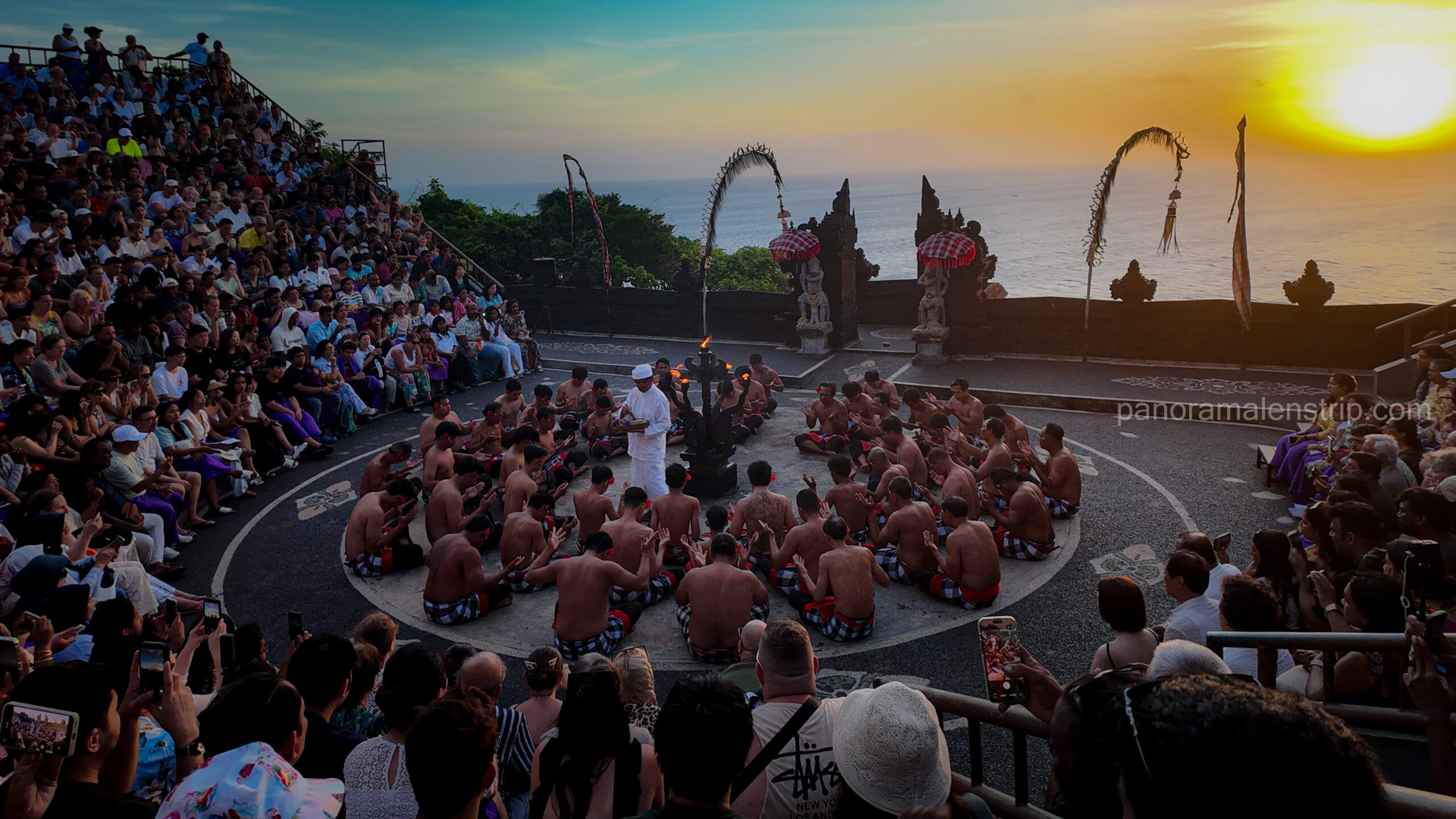
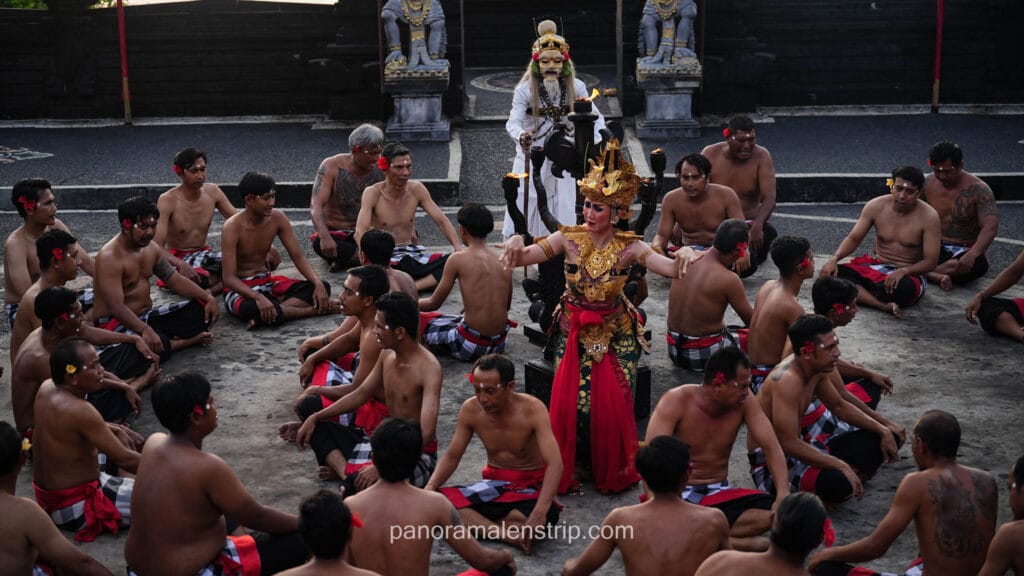
The Kecak Fire Dance — Uluwatu’s signature cultural performance — runs only at 6:00 PM daily. It is exclusive to the sunset window. This 45-minute ceremonial performance features 70 or more male performers. They chant rhythmically around a central fire column. The combination of fire light, golden sky, and ocean backdrop creates a scene that cannot be replicated at any other time of day.
Daytime Visit vs. Sunset Visit: A Direct Comparison
| Feature | Daytime Visit | Sunset Tour |
|---|---|---|
| Light Quality | Harsh overhead; flat shadows | Soft, directional golden hour light |
| Color Temperature | Neutral white (5,500–6,500K) | Warm amber-gold (2,000–3,500K) |
| Air Temperature | 32–35°C (90–95°F) | 26–29°C (79–84°F) |
| Crowd Level | Moderate (tour buses peak at 10–2 PM) | Focused but manageable post-4 PM |
| Kecak Fire Dance | Not available | Daily at 6:00 PM |
| Photography Appeal | Low–moderate | Very high |
| Ocean Visibility | Hazy UV glare | Clear, color-saturated horizon |
| Best For | Quick temple visit on a tight itinerary | Photography, culture, full experience |
When Is the Exact Golden Hour at Uluwatu Throughout the Year?
Golden hour at Uluwatu begins approximately 45–60 minutes before sunset. It ends at the moment the sun drops below the horizon. In Bali, sunset times range from approximately 5:45 PM (June) to 6:30 PM (December). The golden hour window is consistent throughout the year. Arriving by 4:30 PM secures the full light progression from blue hour through full golden color.
How Does Bali’s Position Near the Equator Affect Sunset Timing?
Bali sits at approximately 8° south of the equator. This geographic position produces a predictable, near-vertical sun path. Sunsets occur within a roughly 45-minute window year-round. There is no dramatic seasonal shift like those experienced at higher latitudes in Europe or North America. For international photographers flying in from Paris, London, or Sydney, this consistency is a major logistical advantage. The golden hour window at Uluwatu is reliable, narrow, and repeatable across all twelve months.
What Are the Best Months for an Uluwatu Sunset Photography Tour?
The dry season, from May through October, offers the clearest skies and most stable light. July and August are peak months for overall visibility. However, the wet season from November through April is not automatically inferior for photography.
Counter-Narrative: Why “Clear Skies” Is Not Always the Photographer’s Best Condition
A cloudless sky at sunset produces a clean gradient. It is visually clean but compositionally simple. Our lead guides at Panorama Lens Trip consistently observe that the most dramatic golden hour images come from sessions with partial cloud cover. Scattered altocumulus clouds at 3,000–5,000 meters act as reflectors. They absorb and re-emit golden light in multiple directions simultaneously. This creates layered color gradients — deep crimson at the horizon, amber in the mid-sky, and violet above. These conditions occur most reliably in the transitional months of April, October, and early November. If you plan an Uluwatu sunset photography tour, do not automatically dismiss the shoulder season.
Monthly Sunset Photography Conditions at Uluwatu:
| Month | Sky Condition | Color Drama | Photographer Rating |
|---|---|---|---|
| January–February | Frequent clouds/rain | High (dramatic) | ★★★★☆ |
| March–April | Transitional; mixed | Very high | ★★★★★ |
| May–June | Clear, dry | Moderate-high | ★★★★☆ |
| July–August | Clear, dry | Moderate | ★★★☆☆ |
| September–October | Transitional | Very high | ★★★★★ |
| November–December | Increasing rain | High (with luck) | ★★★★☆ |
What Will You Actually See and Photograph at Uluwatu at Sunset?
Uluwatu Temple (Pura Luhur Uluwatu) sits on a 70-meter (230-foot) vertical sea cliff. The cliff faces due west over the Indian Ocean. At sunset, the entire western sky becomes the backdrop. The temple’s black stone parapets appear as sharp silhouettes against an ocean turned gold and crimson. The wave action 70 meters below adds kinetic energy to long-exposure images.
How Does the 70-Meter Sea Cliff Create Unique Compositional Opportunities?
The cliff’s height and orientation allow photographers to compose shots on multiple vertical planes simultaneously. A wide-angle lens (16–24mm full-frame equivalent) captures the full scene: sky, ocean, cliff face, and temple architecture in one frame. A standard zoom (35–50mm) isolates the temple spire against the sunset. A telephoto lens (85–135mm) compresses the distance between distant cliff formations. The result is a layered, three-dimensional image that flat inland locations cannot produce. The cliff also eliminates horizon-level obstructions. There are no palm trees or buildings between the lens and the ocean. This gives photographers a clean compositional baseline.
Also read: Uluwatu Tour: The Complete Guide to Bali’s Sunset Cliff Temple
What Does the Kecak Fire Dance Add to the Sunset Photography Experience?
The Kecak Fire Dance begins at 6:00 PM inside Uluwatu’s purpose-built ocean-facing amphitheater. Approximately 70 male performers create a continuous rhythmic chant. They surround a central fire column. The performance runs for 45 minutes. The timing is deliberate — the first half unfolds during golden hour, and the second half crosses into blue hour as the fire becomes the primary light source.
This dual-light transition creates a unique photography challenge. During the first 20 minutes, the dancer’s skin tones glow with warm ambient reflected light from the sky. A typical exposure setting might be ISO 800, f/2.8, at 1/200s. In the final 15 minutes, available light drops rapidly. Photographers must transition to ISO 3200–6400. The fire column becomes the key light. This shift tests exposure instinct and demands fast, decisive adjustments. The result — fire-lit performers against a deep blue twilight ocean — is one of the most sought-after images in Bali travel photography.
How Should You Prepare Your Camera Gear for an Uluwatu Sunset Tour?
Gear preparation for an Uluwatu sunset tour requires addressing three specific challenges: high-contrast backlit scenes, rapidly decreasing light levels, and the transition from outdoor natural light to indoor fire-lit performance. Carrying the right kit eliminates missed shots and reduces post-processing time significantly.
Which Lens Focal Lengths Work Best at Uluwatu’s Cliff Edges?
Three focal length ranges cover the full spectrum of images available at Uluwatu. A wide-angle lens (16–24mm) captures environmental context shots — the full cliff, ocean, and sky. A standard lens (35–50mm) isolates the temple architecture cleanly. A short telephoto (85–135mm) works for Kecak dance portraits and compressed background shots where the ocean appears large relative to the subject. Carrying two lens options — a wide-angle and a short telephoto — covers 90% of available scenes without requiring a full kit change during the session.
How Do You Handle the Exposure Triangle When Shooting Into the Setting Sun?
Shooting directly toward a bright ocean horizon creates a high-contrast exposure challenge. The sun and sky are significantly brighter than the cliff and temple in shadow. Three techniques address this effectively.
Technique 1 — Silhouette Exposure: Expose for the sky. Set aperture at f/8–f/11. Meter off the brightest sky region, not the temple. The cliff and temple become clean black silhouettes. This is the most graphic and reproducible technique for golden hour.
Technique 2 — HDR Bracketing: Shoot a three-frame bracket at ±2EV. Blend the exposures in post-processing. This preserves full shadow detail in the cliff face and full highlight detail in the sky simultaneously. Requires a tripod for precise alignment.
Technique 3 — Graduated ND Filter: A 3-stop hard-edge GND filter placed with the gradient line at the horizon darkens the bright sky by three stops. The cliff and temple retain natural exposure. This is the preferred single-capture technique for photographers who want final images straight from camera with minimal processing.
How Do You Get to Uluwatu Temple for the Sunset Tour?
Uluwatu Temple (Pura Luhur Uluwatu) is located on the southernmost tip of the Bukit Peninsula, Bali. It sits approximately 30 kilometers south of Seminyak, 45 kilometers southwest of Ubud, and 15 kilometers west of Nusa Dua. Journey times vary significantly by departure time due to Bali’s afternoon traffic patterns.
Where Is Uluwatu Located Relative to Seminyak, Ubud, and Nusa Dua?
| Departure Point | Distance | Estimated Drive Time (Pre-4 PM) |
|---|---|---|
| Seminyak | ~30 km | 45–60 minutes |
| Kuta / Airport | ~25 km | 40–55 minutes |
| Ubud | ~45 km | 75–90 minutes |
| Nusa Dua | ~15 km | 25–35 minutes |
| Canggu | ~35 km | 55–75 minutes |
What Transport and Arrival Strategy Gives You the Best Sunset Position?
Private transport is strongly recommended for an Uluwatu sunset tour. Shared shuttles and ride-hailing services cannot guarantee departure times from the temple — critical if you plan to stay through blue hour into the Kecak dance. A private driver waits on-site and departs on your schedule.
The optimal arrival window is 4:30–5:00 PM. This gives 45–60 minutes to walk the cliff path, identify compositions, and set up tripods before golden hour begins. Note that temple entry requires a sarong and sash. These are available for rent at the gate for a small fee. Photography inside the inner sanctuary is restricted. The public cliff-edge pathways and amphitheater areas offer unrestricted access.
How Does an Uluwatu Sunset Tour Fit Into a Broader Indonesia Photography Itinerary?
Uluwatu is one of the most accessible and consistently rewarding golden hour locations in Indonesia. It functions naturally as the opening or closing chapter of a longer multi-destination photography journey. Bali’s infrastructure and international flight connections make it a logical entry and exit point for any Indonesia itinerary.
Which Other Bali Locations Pair Naturally With an Uluwatu Sunset Session?
Bali offers a logical sequence of photography locations across different times of day. Morning sessions at Tegalalang Rice Terraces (Ubud) capture low-angle sunrise light across terraced green geometry. Midday allows for transit, gear maintenance, or interior temple visits. The late afternoon and evening belong to Uluwatu. After the Kecak dance concludes near 7:00 PM, a 20-minute drive north leads to Jimbaran Bay. Seafood restaurants line the beach there. Candlelit tables sit directly on the sand. The scene offers an unhurried end to a full photography day — and a completely different low-light composition for those still holding a camera.
Tanah Lot, another clifftop sea temple located on Bali’s northwest coast, also offers a sunset position. However, Uluwatu’s greater cliff height, the Kecak performance, and the unobstructed 180-degree ocean view make it the superior photography location of the two.
Can the Uluwatu Tour Be Extended Into a Multi-Island Photography Journey?
Indonesia spans 17,000 islands. Bali serves as the gateway to an extraordinary range of photography environments. From Bali, direct or short-connection flights reach the following destinations, each offering a completely distinct photographic character.
- Komodo National Park (East Nusa Tenggara): Pink sand beaches, open savanna, Komodo dragons, and some of the world’s most biodiverse coral reefs. Sunset from Padar Island’s ridge is among Indonesia’s most iconic viewpoints.
- Mount Bromo (East Java): Active volcanic caldera, ash plains, and sea-of-sand topography. Pre-dawn starts at 3:30 AM capture the crater rim at blue hour and golden hour simultaneously.
- Raja Ampat (West Papua): Remote island karst topography, turquoise lagoons, and pristine coral. Requires liveaboard or seaplane access. Rewards photographers with above and below waterline imagery unavailable elsewhere.
- Lake Toba (North Sumatra): World’s largest volcanic lake. Surrounded by traditional Batak architecture and highland mist photography conditions.
Each destination requires specific gear preparation, seasonal timing, and logistical coordination. A multi-island itinerary covering Bali, Komodo, and Bromo across 10–14 days is the most frequently requested combination by international photographers traveling with Panorama Lens Trip.
If Uluwatu is the spark, let us map the entire journey. Our team builds bespoke multi-destination Indonesia photography itineraries — combining Uluwatu’s golden hour with Bromo’s volcanic dawn, Komodo’s pink beaches, and Raja Ampat’s open ocean. Take your free consultation now!
What Are the Most Common Mistakes Photographers Make on an Uluwatu Sunset Tour?
Even experienced photographers make avoidable errors on their first Uluwatu session. Understanding these mistakes in advance significantly improves the keeper rate and the overall experience.
Arriving too late. The most common error is arriving at 5:30 PM or later. The pre-golden blue-to-amber transition begins 60–75 minutes before sunset. This transitional window produces some of the most nuanced colors. Photographers who arrive at 5:30 PM miss it entirely. They also miss the opportunity to scout compositions without the pressure of rapidly changing light.
Shooting only the sun. Uluwatu’s drama is not the sun disk itself — it is everything the sun illuminates. The cliff face receives warm reflected light from the sky. The wave foam below glows amber. The temple stonework shows texture it lacks at any other time of day. Photographers who shoot only toward the sun miss the scenes directly available on the east-facing and north-facing cliff sections.
Underestimating crowd positioning for the Kecak amphitheater. The amphitheater seats approximately 500 people. The front rows and right-side positions offer the best ocean-backdrop compositions. These fill 30–45 minutes before the 6:00 PM performance begins. Photographers who prioritize cliff shooting until 5:45 PM will find the prime positions occupied. Plan to transition from cliff photography to amphitheater positioning by 5:15–5:20 PM.
Ignoring the east-facing cliff for reflected light. Most visitors face west toward the sun. The east-facing cliff sections receive beautiful reflected warm light from the sky behind the photographer. These sections also show surface detail — rock texture, breaking waves, and occasional cliff swallows (the temple’s resident bird) — that the backlit western view cannot produce.
Not accounting for the exposure shift during the Kecak dance. Photographers who set exposure for the golden sky and don’t adjust as light drops will produce correctly exposed sky and underexposed performers by the final 15 minutes. The transition from ambient to fire light requires active ISO and shutter adjustment. Use Auto ISO with a defined maximum ceiling (ISO 6400 on modern mirrorless systems) if you want continuous auto-adjustment. Manual shooters should pre-plan an exposure strategy before the performance begins.
Is the Uluwatu Sunset Tour Worth It for Non-Photographers?
The Uluwatu sunset tour delivers exceptional value entirely independent of photography. The experience operates on three distinct levels — cultural, atmospheric, and gastronomic — each of which stands on its own merit.
The Kecak Fire Dance is one of Bali’s defining cultural performances. It is performed specifically at Uluwatu because the ocean backdrop is central to its visual drama. The performance narrates a chapter of the Ramayana Hindu epic. The 70-voice chant creates an immersive sound experience that recordings cannot replicate. For travelers from Europe, the US, or Australia encountering Balinese Hindu ceremony for the first time, this is an experience of genuine cultural depth.
The atmosphere at 70 meters above the Indian Ocean at dusk requires no camera to appreciate. The drop in temperature, the shift in light, and the sound of deep-water swells against the base of the cliff create a sensory environment entirely distinct from any inland Bali experience.
After the performance concludes, the Jimbaran Bay seafood dinner offers a natural and unhurried conclusion. Open-air restaurants along the beach serve fresh grilled fish, prawns, and lobster at tables on the sand. The combination — Kecak dance at Uluwatu, then dinner on the beach at Jimbaran as the stars appear — is one of the most complete single-evening experiences in all of Bali, with or without a camera.
Frequently Asked Questions About the Uluwatu Sunset Tour
What time does the Kecak dance start at Uluwatu?
The Kecak Fire Dance at Uluwatu Temple starts daily at 6:00 PM. The performance lasts approximately 45 minutes. Tickets are purchased at the amphitheater entrance, separate from the temple entry fee. Arrive by 5:15–5:20 PM to secure prime seating positions in the front rows or on the right side for the best ocean backdrop alignment.
How long does the Uluwatu sunset tour typically last?
A complete Uluwatu sunset tour runs 3–4 hours. Allow 60–90 minutes for the cliff walk, temple grounds, and pre-golden hour photography. The Kecak dance runs 45 minutes. Add 30 minutes for post-dance photography and departure. If a Jimbaran Bay dinner is included as the evening’s conclusion, the total experience extends to 5–6 hours from arrival at Uluwatu.
Is Uluwatu Temple open to tourists during the sunset?
Yes. Uluwatu Temple (Pura Luhur Uluwatu) is open to the public daily from approximately 9:00 AM until after the Kecak dance concludes at approximately 7:00 PM. Entry requires a sarong and sash. These are available for rent at the gate for approximately IDR 15,000–20,000 (roughly USD 1–1.50). Entry fee is approximately IDR 50,000 per person for foreign visitors.
What should I wear to Uluwatu Temple at sunset?
A sarong and sash are compulsory and are available for rental at the gate. Beyond the temple requirement, lightweight, breathable clothing is recommended. The cliff path can be windy, particularly in the dry season (June–September). Closed-toe shoes are advisable — the cliff path includes uneven stone steps. Monkeys inhabit the temple grounds; avoid wearing loose accessories or dangling jewelry that they may attempt to remove.
Can I combine the Uluwatu sunset tour with a Jimbaran seafood dinner?
Yes, and this combination is highly recommended. Jimbaran Bay is located approximately 20 minutes north of Uluwatu by private transport. The Kecak dance ends near 7:00 PM. Arrival at Jimbaran for dinner between 7:30 and 8:00 PM is realistic. The bay’s beachfront restaurants serve seafood grilled over coconut husks. Dining takes place directly on the sand. This pairing — cultural performance at sunset followed by an ocean-side dinner under stars — is the standard sequence for a complete Uluwatu evening.
Is the Uluwatu sunset tour suitable for beginners with a camera?
Uluwatu is an excellent location for beginner photographers precisely because of its simplicity. The scene is inherently dramatic. Good images are achievable with minimal technical knowledge. The golden hour light does much of the compositional work automatically. A beginner with a smartphone or a basic mirrorless camera in Auto or Aperture Priority mode can produce compelling silhouette images of the temple against the sunset. For those who want to develop their technique, the Kecak dance sequence provides a structured opportunity to practice ISO management in a changing-light environment.
Final Verdict: Why the Uluwatu Sunset Tour Belongs on Your Indonesia Itinerary
The Uluwatu sunset tour earns its reputation because every element converges at the same moment. The light, the cliff, the cultural performance, and the topography are all optimized simultaneously at dusk. No other time of day at this location produces an equivalent result.
For photographers, Uluwatu at golden hour represents a technically straightforward scene that rewards creative decision-making. Wide angles, telephoto compression, silhouette exposure, and fire-lit performance photography are all available within a 90-minute window from a single location.
For travelers seeking cultural depth, the Kecak Fire Dance at the cliff edge is authentic, site-specific, and irreplaceable. For those simply seeking a superlative evening in Bali, the sequence of golden light, ocean air, ceremonial fire, and a candlelit dinner on the beach is without equal.
Uluwatu is also a natural starting point. Indonesia’s photographic landscape extends far beyond Bali’s coast. Volcanic calderas, remote island chains, pink beaches, and ancient sea temples await across 17,000 islands. The sunset tour at Uluwatu is, for many photographers, the moment they decide to return — and to go further.
Panorama Lens Trip designs specialized photography tours and premium long day tours across Indonesia. Our itineraries are built around golden hours, not bus schedules — for photographers and travelers who want to see Indonesia at its most extraordinary.