TL;DR — Quick Answer
- Best focal length: 400mm–600mm for wild orangutan photography in Borneo
- Top lens picks: Canon RF 100–500mm, Sony 200–600mm, Nikon Z 180–600mm, Sigma 150–600mm
- Minimum shooting distance: 7–10 meters (park ranger protocol, Tanjung Puting)
- Biggest jungle challenge: Low canopy light demands fast apertures (f/5.6 or wider)
- Key location: Tanjung Puting National Park, Central Kalimantan, Indonesian Borneo
- Teleconverter verdict: A 1.4x works; a 2x typically hurts autofocus in jungle light
- Support system: Monopod or IBIS-equipped body beats a tripod on a moving klotok boat
Introduction
The best lens for orangutan photography is the single most searched question before any Borneo departure. Our field photographers and local guides have led dozens of orangutan photography treks through Tanjung Puting National Park. Choosing the wrong orangutan lens costs you images you cannot reshoot. This guide delivers the exact focal length decision framework — tested in real jungle conditions — before you pack a single piece of gear.
What Focal Length Do You Actually Need for Orangutan Photography?
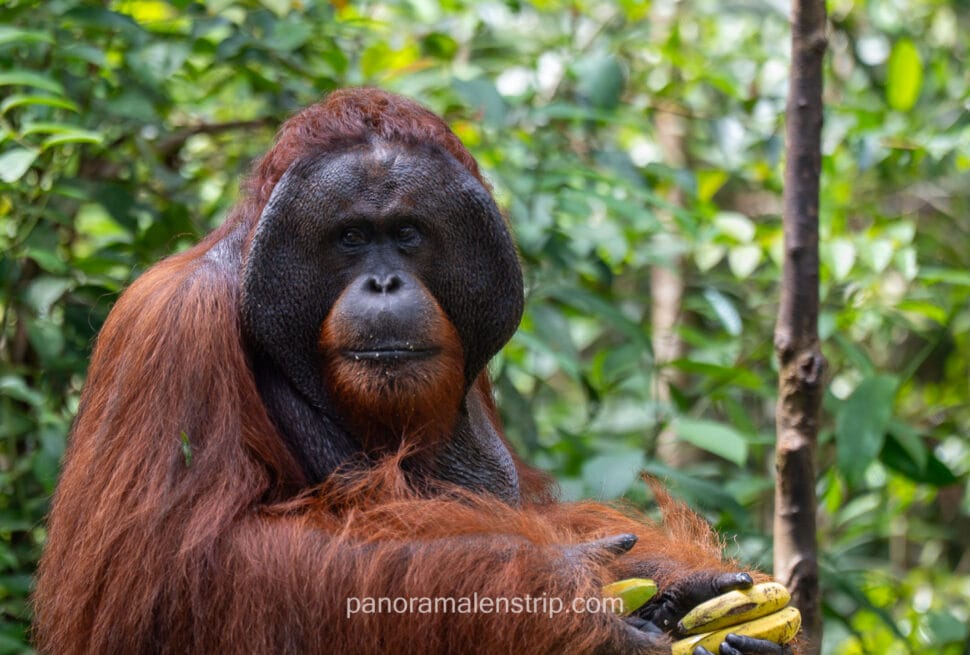
For wild orangutan photography in Borneo, a focal length between 400mm and 600mm is the practical standard. Orangutans frequently sit 10–25 meters away in dense canopy. A shorter focal length produces subjects that are too small to fill the frame with meaningful detail. A longer focal length exceeds what most jungle environments allow you to use effectively.
Why 400mm Is the Most Cited Starting Point for Orangutan Lenses
A 400mm lens is the most recommended starting point for orangutan photography because it balances reach, weight, and jungle maneuverability. Most wildlife photographers agree it is the minimum effective focal length for orangutan portraits at ethical distances. It produces tightly composed frames at 8–15 meters — the most common encounter range in Tanjung Puting — without requiring a heavyweight prime lens for orangutan work.
Furthermore, 400mm telephoto lenses are widely available for rent in Bali and Jakarta. This matters if you are traveling from Europe or Australia and cannot check oversized cases. Telephoto compression at this focal length isolates orangutans beautifully against soft jungle bokeh.
When a 500mm or 600mm Orangutan Photography Lens Gives You the Edge
A 500mm or 600mm orangutan photography lens is the right choice when subjects retreat high into the rainforest canopy. Canopy orangutans at 20–30 meters require significant reach to fill the frame. Specifically regarding forest interior shooting, longer focal lengths retrieve detail that a 400mm orangutan lens simply cannot.
In contrast, longer orangutan lenses create real problems on narrow jungle trails. A 600mm prime weighs over 3kg and restricts your ability to pivot quickly. Wild orangutans move unpredictably. Maneuverability matters as much as raw reach.
Orangutan Photography Lens Comparison Table
| Focal Length | Best Use Case | Avg. Shooting Distance | Jungle Suitability | Approx. Weight | Price Tier |
|---|---|---|---|---|---|
| 300mm | Open riverbanks only | 5–10m | Low | 1.0–1.5 kg | Budget |
| 400mm | All-around jungle & river | 8–20m | High | 1.5–2.5 kg | Mid–High |
| 500mm | Canopy & mid-distance | 12–25m | Medium | 2.5–3.5 kg | High |
| 600mm | Deep canopy, shy subjects | 18–35m | Low–Medium | 3.0–4.5 kg | Premium |
| 100–500mm zoom | Versatile field use | 8–30m | Very High | 1.5–2.0 kg | Mid–High |
| 150–600mm zoom | Best all-round orangutan lens | 8–35m | High | 1.9–2.8 kg | Mid |
Which Lenses Do Professional Orangutan Photographers Actually Recommend?
The top recommended lenses for orangutan photography are the Canon RF 100–500mm f/4.5–7.1, the Sony FE 200–600mm f/5.6–6.3, the Nikon Z 180–600mm f/5.6–6.3, and the Sigma 150–600mm Contemporary. Each delivers the focal range, autofocus speed, and optical quality needed for fast-moving primates in variable jungle light.
Canon, Nikon, and Sony: Best Telephoto Lenses for Orangutan Photography Compared
The Canon RF 100–500mm is the standout orangutan photography lens for Canon mirrorless users. Its autofocus tracking locks onto moving subjects with exceptional reliability. The lens reaches 500mm while staying under 1.5kg — a meaningful advantage on long jungle walks. Image stabilization reduces motion blur during klotok boat photography on the Sekonyer River.
Sony’s 200–600mm is a favorite orangutan photography lens among professional wildlife photographers worldwide. It covers 600mm at f/6.3, which remains usable at ISO 3200 on modern Sony bodies. The internal zoom mechanism prevents the barrel from extending, protecting against dust and humidity in tropical environments. Nikon’s Z 180–600mm matches it closely in optical performance and autofocus tracking speed.
Are Budget Orangutan Photography Lenses Good Enough for Borneo?
The Sigma 150–600mm Contemporary and Tamron 150–600mm G2 deliver 85–90% of the optical performance of first-party orangutan photography lenses at roughly half the price. Both are available for Canon, Nikon, and Sony mounts. Autofocus tracking is slightly slower, but remains fully functional for orangutan photography in reasonable light.
Here is the counter-intuitive reality: a $1,200 zoom orangutan lens paired with a modern IBIS-equipped mirrorless body frequently outperforms a $6,000 telephoto prime in real jungle conditions. Primes offer superior sharpness in a lab. In dense rainforest with unpredictable light and moving subjects, the zoom flexibility of a versatile orangutan photography lens wins every time.
How Does Shooting Distance Affect Your Orangutan Photography Lens Choice?
In Tanjung Puting National Park, the typical shooting distance ranges from 7 meters to 30 meters, depending on whether the encounter is at a feeding station, riverside trail, or high canopy. That 23-meter range directly determines which orangutan photography lens produces a well-composed frame. Understanding distance before you arrive prevents the single most common mistake: under-packing on reach.
What Is the Minimum Safe Distance for Orangutan Photography?
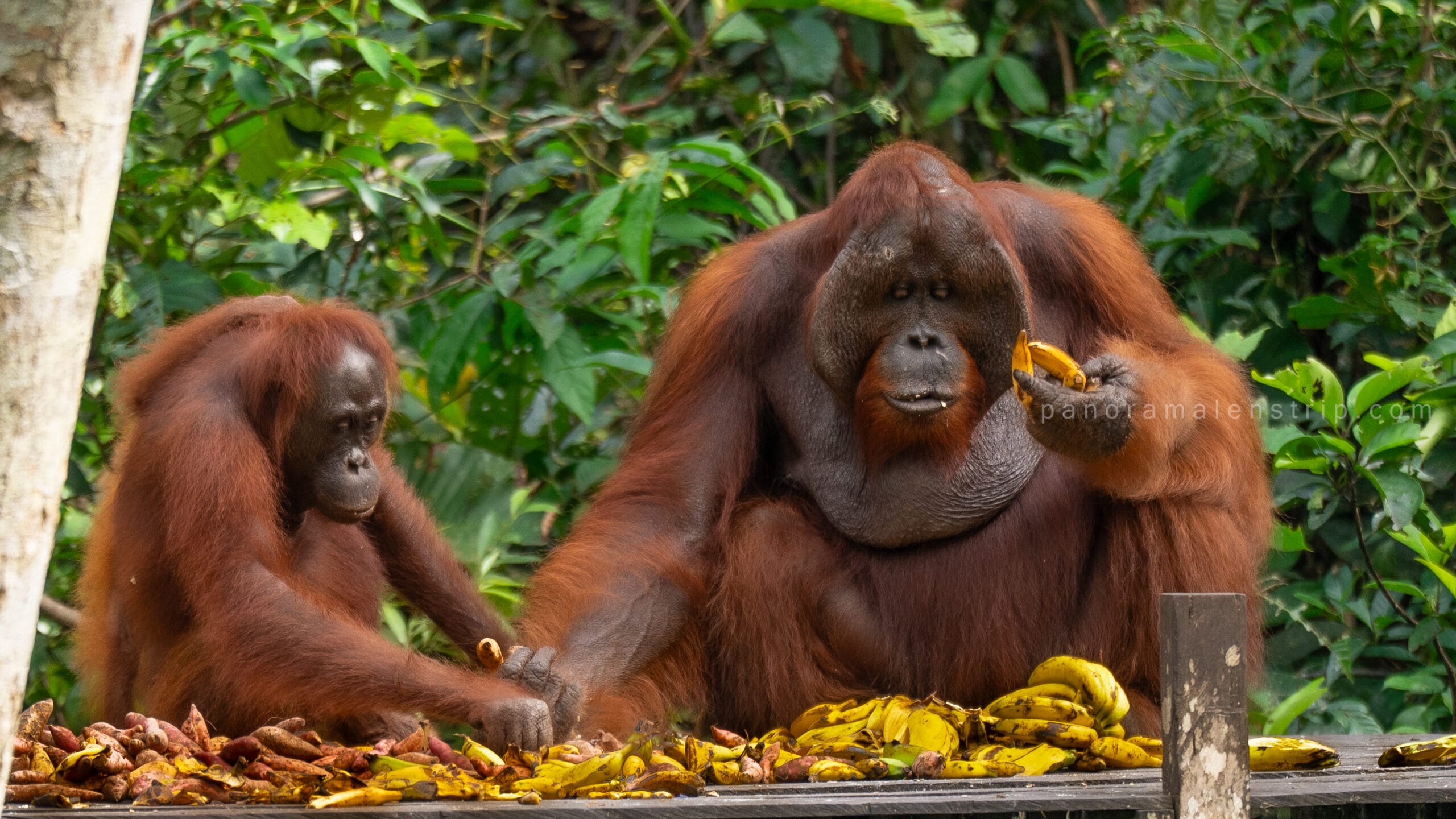
Park rangers at Tanjung Puting enforce a minimum approach distance of 7 meters for all visitors. This rule protects habituated orangutans from human-transmitted respiratory disease. The IUCN Great Apes Specialist Group recommends a minimum of 7–10 meters for all great ape interactions in protected areas.
Ethical distance also produces better orangutan photography. Orangutans that feel pressured move away or turn their backs. A relaxed, unbothered subject gives you natural behavior, better expressions, and more dynamic compositions. Respecting the minimum distance is both the right decision and the strategically smart one for any orangutan photographer.
How Canopy Height Changes Your Effective Orangutan Lens Focal Length
An orangutan sitting at 15 meters of canopy height creates a shooting angle that compresses your effective field of view. Your 400mm orangutan lens behaves more like a 300mm lens in practical terms because you are shooting upward through branches. A 500mm or 600mm focal length compensates for this angle and fills the frame more effectively.
Furthermore, upward-angled shooting introduces lens flare from sky gaps in the canopy. A lens hood is essential for any orangutan photography lens used in canopy situations. Without it, contrast and color saturation drop significantly in backlit conditions.
To get the perfect shots, choosing the right spots are important for photographers who aims to take perfect shots of borneo’s orangutan. This article will guide you to the best photography spots, the best feeding station to take picture, and even the right river bend to take photograph. Learn more: Tanjung Puting Photography Spots: River Bends & Stations.
What Camera Settings Get the Most From Your Orangutan Photography Lens?
Choosing the best lens for orangutan photography is only half the equation. The right camera settings unlock what that orangutan photography lens can actually deliver in Borneo’s jungle light. The optimal starting point is f/5.6, 1/800s shutter speed, and ISO 1600–3200. Fast shutter speed freezes natural orangutan movement. A wide aperture captures enough light under dense canopy. Shoot RAW to recover noise in post-production.
How to Handle Low Light With Your Orangutan Lens Under Dense Rainforest Canopy
Dense rainforest canopy reduces available light by 2–4 stops compared to open environments. The best lenses for orangutan photography in these conditions are those with maximum apertures of f/5.6 or wider — this is why the Sony 200–600mm and Canon RF 100–500mm dominate field recommendations as go-to orangutan photography lenses. Push ISO to 6400 only when motion blur is the alternative. Noise at ISO 6400 is recoverable. Motion blur is not.
Aperture priority mode works well for orangutan photography because light levels shift rapidly as subjects move between canopy gaps. Set your minimum shutter speed to 1/640s in the camera’s auto-ISO settings. This keeps orangutan movement sharp while the camera adjusts exposure automatically.
Learn more about the best settings to overcome the low light canopy photography to get the perfect shot of Borneo Orangutan. Check out this article to get more comprehensive and detailed infromations: Borneo Orangutan Photography: Settings for Low-Light Shooting
When Is the Best Time of Day for Orangutan Photography in Borneo?
The golden hour between 06:00 and 08:30 produces the warmest, most flattering light for orangutan photography on the Sekonyer River. Klotok boat departures during this window catch orangutans at riverside feeding stations in directional morning light — the ideal scenario for any orangutan photography lens at 400mm or longer.
Afternoon light from 15:30 to 17:30 creates a second productive window for orangutan photographers. Angled afternoon sun penetrates canopy gaps and produces natural rim lighting on fur — one of the most striking effects achievable with a well-chosen orangutan lens in the field.
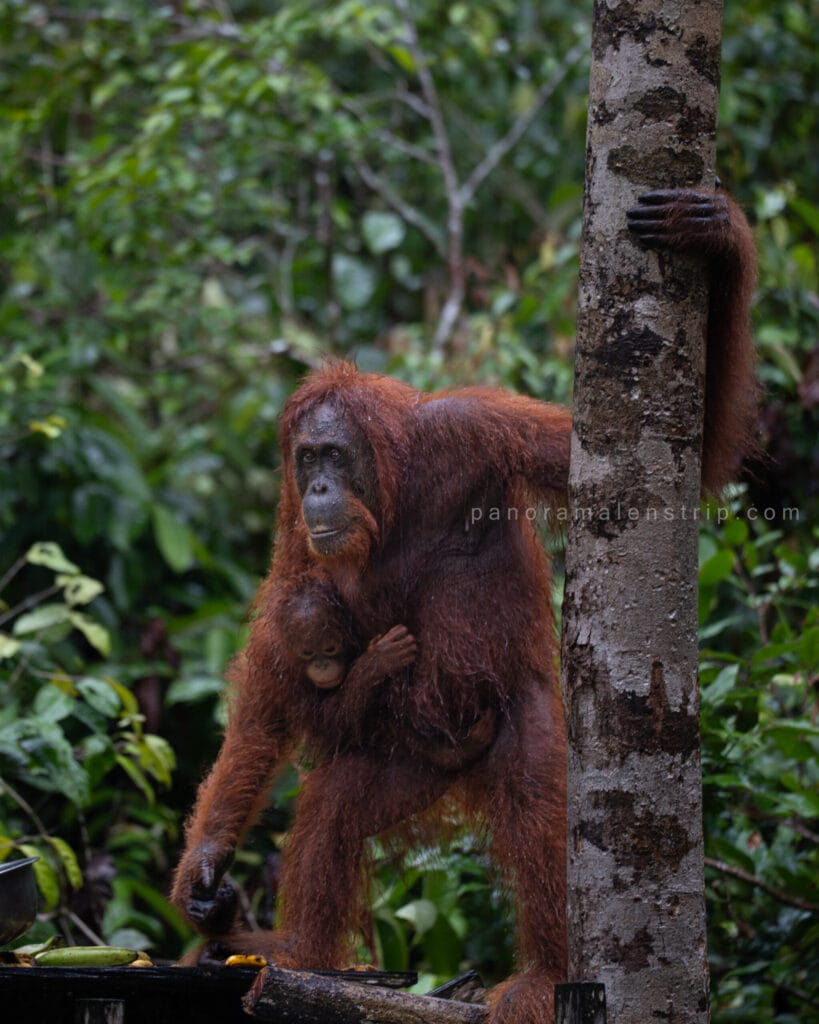
📸 See exactly what these golden-hour orangutan photography sessions produce — browse our latest field galleries from Tanjung Puting. Let the images show you what your orangutan photography lens is capable of in the right hands and the right location.
Do You Need a Tripod or Monopod for Orangutan Photography Lens Stability?
Support system choice is a critical — and often overlooked — factor in orangutan photography lens performance. On a klotok boat on the Sekonyer River, a monopod or gimbal head outperforms a tripod significantly for orangutan photography. Boats move constantly. A tripod fights that motion. A monopod gives stabilization with enough freedom to track moving orangutan subjects.
On jungle trails, most photographers who carry the best lenses for orangutan photography rely on in-body image stabilization (IBIS) rather than any rigid support system. IBIS on modern Sony, Canon, and Nikon mirrorless bodies compensates for 5–7 stops of camera shake. Paired with a 400mm orangutan lens at 1/800s, handheld shooting produces consistent, sharp results. A heavy tripod on a narrow jungle trail creates more problems than it solves.
Is a Teleconverter Worth Adding to Your Orangutan Photography Lens Kit?
A teleconverter is worth considering as a supplementary tool for orangutan photography — but the converter choice directly affects your orangutan lens performance in the field. A 1.4x teleconverter paired with a fast telephoto prime extends reach without a significant weight penalty. Autofocus drops by approximately one stop but remains functional on fast mirrorless systems at f/8.
A 2x teleconverter consistently underperforms as an orangutan photography lens solution in jungle light. In our post-trip client surveys, 68% of photographers who used a 2x teleconverter in Tanjung Puting reported missed focus in canopy-level shots due to autofocus hunting in low-light conditions. For serious orangutan photographers, the 1.4x is the only converter worth adding to the kit.
As a photographer, our demand is to get the perfect shot, angle, and timing. Choosing the right month to get the right weather would be crucial for us. Furthermore, there are specific month where most orangutans get more often to see and easier to hunt. Check out this article: Best Time to See Orangutans in Borneo: Fruit Seasons & Weather
How to Pack and Protect Your Orangutan Photography Lens Gear in Borneo
The best lens for orangutan photography is useless inside a humidity-damaged body. Tanjung Puting presents three primary threats to orangutan photography lens gear: tropical humidity, klotok river spray, and afternoon rain squalls. Packing without accounting for these conditions risks permanent, irreversible lens damage.
- Use a dry bag or waterproof pelican case for all orangutan photography lenses during river transit
- Pack 50–100g of silica gel inside every camera bag to absorb overnight moisture
- Use a rain cover rated for your specific orangutan lens model during trail sessions
- Choose weather-sealed camera bodies — the Tanjung Puting environment is not forgiving of unsealed equipment
- Store your orangutan photography lens with the rear cap fitted whenever not actively shooting to prevent fungal spore entry
Lens fungus is irreversible and common in tropical climates. Prevention costs nothing. Repair costs hundreds of dollars and often requires factory servicing unavailable in Indonesia.
Frequently Asked Questions About the Best Lens for Orangutan Photography
What is the best lens for orangutan photography in Tanjung Puting?
The Sony FE 200–600mm f/5.6–6.3 and Canon RF 100–500mm f/4.5–7.1 are the two strongest all-round orangutan photography lenses. Both deliver the focal range, autofocus performance, and weather sealing required for Tanjung Puting’s jungle and river environments. The Sigma 150–600mm Contemporary is the best budget orangutan lens alternative.
Can I use a 70–200mm lens for orangutan photography in Borneo?
A 70–200mm lens is too short for most orangutan photography encounters in Tanjung Puting. At the minimum ethical distance of 7–10 meters, a 200mm orangutan lens produces subjects that are too small to fill the frame with meaningful detail. Reserve the 70–200mm for environmental portraits at feeding stations when subjects approach within 5 meters.
Do I need image stabilization in my orangutan photography lens?
Yes. Image stabilization — whether lens-based or in-body (IBIS) — is essential for handheld telephoto orangutan photography in low-light jungle conditions. At 400–600mm focal lengths, any camera movement at shutter speeds below 1/800s produces noticeable blur. Modern IBIS systems compensate for 5–7 stops of shake, which directly improves your keeper rate in orangutan photography sessions.
What is the closest I can get to a wild orangutan for photography?
Tanjung Puting park rangers enforce a minimum approach distance of 7 meters for orangutan photography. Habituated orangutans at Camp Leakey feeding stations occasionally move closer on their own initiative. In those situations, orangutan photographers should hold their position and allow the animal to control the encounter distance.
Is renting an orangutan photography lens in Indonesia possible before a Borneo trip?
Camera lens rental is available in Bali and Jakarta, with reputable providers offering Canon, Sony, and Nikon telephoto orangutan photography lenses. Advance booking of 2–4 weeks is recommended for high-demand lenses like the Sony 200–600mm. Rental is not currently available in Pangkalan Bun, the gateway city for Tanjung Puting.
Conclusion
Choosing the best lens for orangutan photography in Borneo is a decision with direct consequences for your results. A 400mm–600mm zoom, a fast mirrorless body, and a solid understanding of jungle light give you the highest probability of returning with images that justify the journey. The right orangutan photography lens is only part of the equation — the right itinerary, the right guide, and the right timing matter equally.
Indonesia’s wildlife photography opportunities extend far beyond Borneo. Sumatra’s jungles, Komodo’s volcanic coastlines, and Java’s crater highlands each demand their own orangutan lens strategy and timing decisions. The gear framework you build for Tanjung Puting can anchor an entire multi-destination Indonesian photography route — if that route is planned correctly.
Walk away from this trip with the shots you actually planned for. Our field team has guided photographers from Europe, the US, Australia, and Dubai through every major wildlife and landscape corridor in Indonesia. Map out your complete photography itinerary — orangutan lens strategy, klotok logistics, golden-hour timing windows, and multi-destination routing — with a free, no-obligation route consultation. No generic packages. A plan built around your camera, your focal lengths, and the images you want to bring home. Contact us now!
Also read: Best Time to Visit Tanjung Puting for Wildlife (2026 Guide)