TL;DR
- A Yogyakarta photography tour delivers access to UNESCO temples, volcanic landscapes, and misty river valleys — all within one region of Java.
- Top sunrise locations include Punthuk Setumbu, Borobudur, and Prambanan Temple Complex.
- Hidden viewpoints like Nglinggo Tea Plantation and Kalibiru National Park reward photographers who arrive early.
- The dry season (May–October) offers sharp contrast; the wet season delivers dramatic skies.
- Wide-angle lenses (16–35mm) and telephoto zooms (70–200mm) are the core kit.
- Panorama Lens Trip structures full-day, multi-destination photography tours across Indonesia with expert local guides.
What Makes Yogyakarta One of Indonesia’s Most Photogenic Destinations?
Yogyakarta is the single most concentrated photography destination in Indonesia. Two UNESCO World Heritage Sites, an active stratovolcano, ancient Hindu-Buddhist temples, and layered rice terraces sit within a 60-kilometer radius. The city’s equatorial position produces extraordinary golden-hour light. Low atmospheric haze during dry months intensifies color saturation and shadow depth across every landscape type.
The regional topography is equally important. Mount Merapi’s caldera dominates the northern skyline. The Menoreh Hills extend west toward Kulon Progo. These geographic features create layered, three-dimensional compositions that reward wide-angle and telephoto techniques alike. Few destinations in Southeast Asia compress this variety into a single touring day.
Where Are the Best Sunrise Spots for a Yogyakarta Photography Tour?
The best sunrise spots in Yogyakarta for photographers are Punthuk Setumbu, Borobudur Temple, and Prambanan Temple Complex. Each location offers a distinct compositional opportunity. The optimal window runs from 45 minutes before civil twilight through the first 30 minutes of golden hour. Arriving late means losing the mist, the color gradient, and the empty foreground.
Punthuk Setumbu — Borobudur Mist & Layered Horizon
Punthuk Setumbu is a low hilltop viewpoint in the Menoreh Hills, northwest of Borobudur. It delivers the classic “floating temple” shot — Borobudur emerging through river valley mist with forested ridgelines stacked behind it. Our guides recommend arriving no later than 05:00 during peak mist season (June–August). A telephoto focal length of 100–200mm compresses the distance between the viewpoint and the temple, intensifying the layered effect. Use a tripod and spot-meter on the brightening sky rather than the dark mist layer below.
The Progo River valley generates ground fog most reliably between late May and early September. Outside this window, the mist thins considerably. Punthuk Setumbu allows a maximum group size of approximately 30 people per day. Independent access requires a pre-booked ticket; Panorama Lens Trip handles logistics and secures priority positioning on the viewing platform.
Borobudur Temple at Dawn — Shooting the Stupa Silhouettes
Borobudur is the world’s largest Buddhist monument. Its nine stacked platforms and 72 perforated stupas create powerful silhouette compositions against a pastel eastern sky. The temple faces east, which means the sunrise angle falls directly behind the central stupa from the upper terrace. For exposure, prioritize the sky’s gradient and let the temple render as a partial silhouette. An aperture of f/8 at ISO 200 is a reliable starting point; adjust shutter speed to hold highlight detail in the horizon.
Standard visitor access opens at 06:00. Panorama Lens Trip clients access the upper terrace during the exclusive Manohara Sunrise Program, which begins well before general opening. This pre-dawn window eliminates crowds from your foreground. The stone carvings also appear most textured in the angled raking light of the first 20 minutes after sunrise.
Prambanan Temple Complex — Early Morning Golden Light
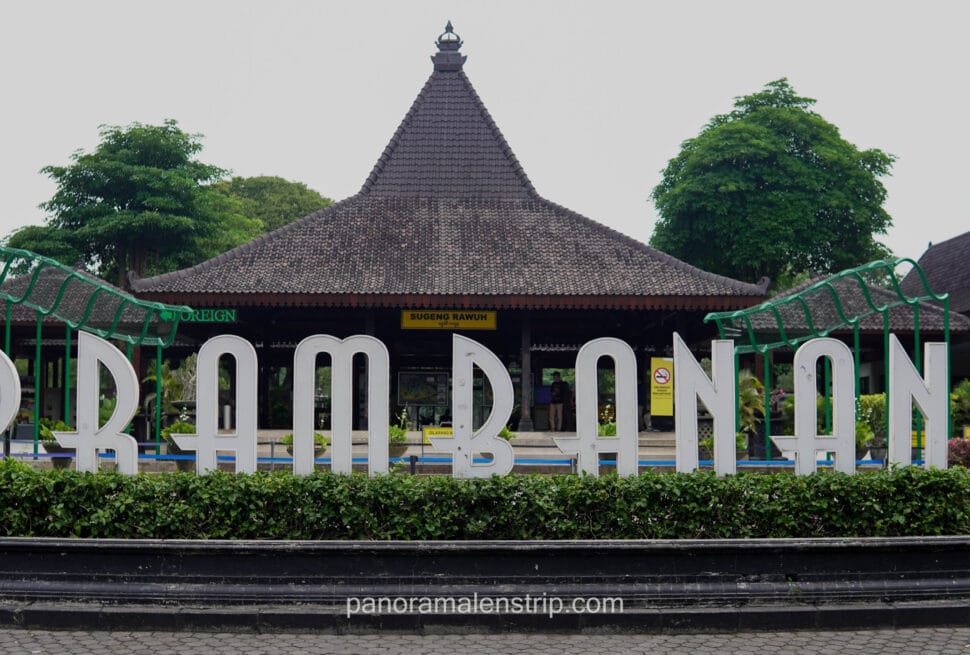
Prambanan is a 9th-century Hindu temple compound featuring three central towers dedicated to Brahma, Vishnu, and Shiva. The tallest tower reaches 47 meters. Its east-facing orientation means the stone façades absorb warm golden light within 10 minutes of sunrise. Shoot from the southern lawn for a three-spire composition, or move to the northeastern perimeter for single-spire isolation against the sky.
A wide-angle lens (16–24mm) works well from close range to emphasize the towers’ verticality. A 50–85mm focal length from the middle ground produces cleaner, less distorted architectural shapes. Arrive by 05:45 to clear the ticketing queue before the golden-hour window opens. Prambanan is 17 kilometers east of central Yogyakarta, making transport timing critical for sunrise shoots.
📸 See what your golden hour shots from Prambanan and beyond could look like. Explore our latest galleries on Instagram, where we share real images from every location on our Indonesia-wide photography routes — posted in real time as our tours happen.
What Are the Hidden Viewpoints Most Photographers Miss in Yogyakarta?
The hidden photography viewpoints most visitors overlook in Yogyakarta are Nglinggo Tea Plantation in the Menoreh Hills and Kalibiru National Park above Sermo Reservoir. Both locations sit within Kulon Progo Regency, approximately 40 kilometers west of the city center. Crowds at these sites are a fraction of those at Borobudur and Prambanan, making them ideal for photography requiring clear foregrounds and unhurried composition.
Nglinggo Tea Plantation — Menoreh Hills’ Secret Terrace
Nglinggo is a working tea plantation at approximately 700 meters elevation in the Menoreh Hills. Its terraced rows create strong leading lines that draw the eye across the frame. Morning light arrives as soft, diffused luminance rather than direct golden-hour glare, which suits high-detail botanical compositions. The low-contrast light also simplifies post-processing, particularly for green-channel recovery in RAW files.
The plantation produces a visible ground mist on cool mornings between April and October. At this elevation, the mist sits below the ridgeline rather than obscuring it — creating a separation between the tea terraces in the foreground and the forested hills behind. A focal length of 35–70mm captures the row geometry cleanly. The site requires a 45-minute drive from central Yogyakarta; a 04:30 departure is necessary to arrive before the soft light disappears.
Kalibiru National Park — Treetop Platforms Over the Reservoir
Kalibiru is a community forest park that offers constructed wooden platforms elevated above the Sermo Reservoir. The platforms enable downward compositions over still water surrounded by jungle-covered hills — a perspective unavailable from ground level. Water-surface reflections in the early morning create a natural mirror effect that doubles the visual complexity of the frame.
Platform height varies between 6 and 15 meters. The 15-meter platform offers the widest reservoir panorama but requires a ladder climb. Drone operation within Kalibiru is restricted without a permit issued by the park authority; Panorama Lens Trip can arrange permit processing in advance for clients who bring aerial equipment. Access roads are unpaved for the final 3 kilometers; four-wheel-drive vehicles are advisable during or after rain.
When Is the Best Time to Join a Yogyakarta Photography Tour?
The best time for a Yogyakarta photography tour depends on the visual style you want to achieve. The dry season (May–October) produces sharp, high-contrast images with consistent golden-hour color. The wet season (December–March) generates dramatic cloud formations and moody atmospheric conditions. The shoulder months of April and November balance low crowd density with transitional light that suits intimate or experimental compositions.
| Season | Months | Light Quality | Crowd Level | Best For |
|---|---|---|---|---|
| Dry Season | May–October | Sharp, high contrast | Moderate–High | Landscape & Architecture |
| Shoulder | April / November | Soft, diffused | Low | Intimate & Moody Shots |
| Wet Season | December–March | Dramatic clouds | Low | Creative / Atmospheric |
A counter-narrative worth considering: The dry season is not automatically superior for photography. Wet season clouds create towering cumulonimbus formations above Borobudur and Prambanan that no graduated ND filter can replicate in post-processing. Rain clears the air of haze, which sharpens distant volcanic profiles like Mount Merapi. Photographers who prioritize drama over convenience consistently produce more distinctive work during December through February. The trade-off is unpredictability — and that unpredictability is precisely what separates an extraordinary shot from a predictable one.
Learn more: Best Time to Visit Yogyakarta
What Camera Gear Do You Need for a Yogyakarta Photography Tour?
A Yogyakarta photography tour demands a two-lens system: a wide-angle prime or zoom (16–35mm) for architectural and landscape compositions, and a telephoto zoom (70–200mm f/2.8 or f/4) for compressing volcanic ridgelines and isolating temple details. A carbon-fiber tripod rated for at least 8 kilograms of payload is essential for pre-dawn long exposures. Add a circular polarizer and a 3-stop ND filter for overcast and midday shooting conditions.
Tropical humidity in Java averages 70–85% year-round. Camera bodies should carry at minimum IPX4 moisture resistance. Carry silica gel desiccant packs inside every bag. Shoot in RAW format exclusively — JPEG compression destroys the shadow recovery latitude that pre-dawn and backlit scenes require. Memory cards rated UHS-II speed class prevent buffer lag during rapid burst sequences at sunrise.
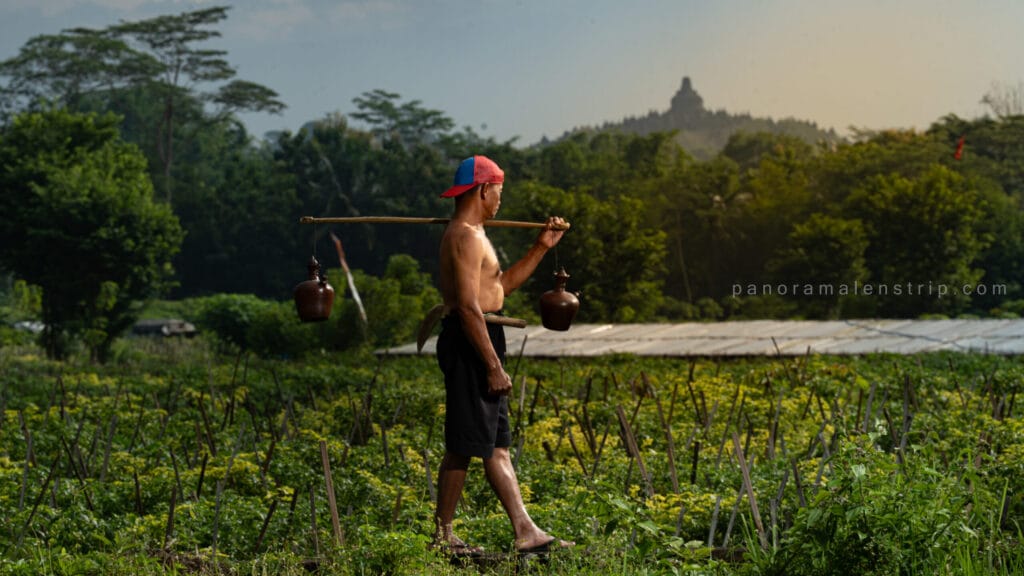
How Does Panorama Lens Trip Structure a Yogyakarta Photography Tour?
Panorama Lens Trip designs long-day photography tours built around natural light windows — not fixed sightseeing schedules. A standard Yogyakarta tour begins before dawn at Punthuk Setumbu or Borobudur, moves to a mid-morning location for architectural detail work, and closes at a landscape or cultural site during the late afternoon golden hour. Groups are capped at six clients per guide to preserve unobstructed access to every viewpoint.
Every itinerary is built around the client’s camera system and creative objectives. Our guides carry location data for more than 40 shooting positions across Yogyakarta and the broader Java region. Tours extend into Dieng Plateau, Mount Bromo, East Java’s coastal cliffs, and Bali’s volcanic interior — all delivered as full-day or multi-day private routes. The goal is not a checklist of landmarks. The goal is returning home with images that accurately represent your skill and vision.
🗺️ Map out your perfect multi-destination Indonesia photography itinerary. Receive a free, no-obligation route consultation tailored to your camera system, creative vision, and travel window — our team will build your ideal Java or island-hopping sequence before you book a single flight. Contact us here!
Frequently Asked Questions About Yogyakarta Photography Tours
Is Yogyakarta suitable for photography beginners?
Yes. Yogyakarta suits photographers at every skill level. Borobudur and Prambanan offer straightforward compositions that produce strong results with basic exposure knowledge. More advanced locations like Punthuk Setumbu and Kalibiru require pre-dawn logistics and precise timing, which Panorama Lens Trip manages on the client’s behalf.
Do I need a guide for sunrise shots at Borobudur?
A guide is not mandatory, but it provides a measurable advantage. Pre-dawn access to Borobudur’s upper terrace through the Manohara Sunrise Program requires advance booking and is most reliably secured through a licensed tour operator. A guide also manages positioning, light timing, and composition briefings in real time.
How many locations can I visit in one photography day tour?
A standard Panorama Lens Trip long-day tour covers two to four locations across a single day. The pre-dawn slot handles sunrise work. A mid-morning slot covers detail or cultural photography. The late-afternoon slot targets golden-hour landscape or architectural work. Travel time between locations is factored into the shooting schedule.
What are the entrance fees for Borobudur and Prambanan?
Entrance fees change periodically and vary by nationality and access tier. As of 2024, international visitor fees for Borobudur have increased significantly under the site’s new management structure. Panorama Lens Trip includes all entrance fees and special access surcharges in its published tour pricing. Confirm current rates directly with the tour operator before booking.
Can I combine a Yogyakarta photography tour with other Indonesian destinations?
Yes. Panorama Lens Trip designs multi-island itineraries combining Yogyakarta with Bali, Lombok, Flores, East Java’s Mount Bromo, and Sumatra. Long-day tour formats mean most destinations can be covered without overnight stays, maximizing shooting windows. A route consultation identifies the optimal sequence based on available travel days and seasonal light conditions.
Conclusion
Yogyakarta remains Indonesia’s most accessible concentration of world-class photography subjects. Punthuk Setumbu delivers the iconic mist-and-temple sunrise. Borobudur’s upper terrace offers pre-dawn exclusivity. Prambanan rewards precise arrival timing with golden stone and clear spire silhouettes. Hidden locations in Kulon Progo — Nglinggo and Kalibiru — add depth, leading lines, and reservoir reflections to any itinerary. Panorama Lens Trip connects serious photographers to all of these locations through expert-guided, light-optimized long-day tours designed for high-net-worth travelers who want more than a tourist photograph.
Also read: Yogyakarta Tour Guide: Culture, Luxury & Photography